Voting Rights 2026: Federal Legislation & State Impacts
The future of voting rights in 2026 will be profoundly shaped by ongoing debates surrounding proposed federal legislation designed to standardize election practices and the subsequent, often contentious, impacts these measures will have on diverse state electoral systems and voter access across the United States.
As the United States approaches the mid-term elections of 2026, the landscape of electoral democracy continues to evolve, bringing the critical discussion of The Future of Voting Rights in 2026: Analyzing Proposed Federal Legislation and State Impacts to the forefront. This complex and multifaceted topic touches the very foundation of American governance, prompting questions about access, equity, and the balance of power between federal and state authorities. Understanding these dynamics is not merely an academic exercise; it is essential for every citizen.
The Current State of Voting Rights: A Fragmented Landscape
The current state of voting rights in the United States is characterized by a fragmented and often inconsistent patchwork of laws and regulations, primarily governed at the state level. This decentralization, while rooted in the nation’s federalist structure, has led to significant disparities in voter access, registration processes, and election administration across different states. As we look towards 2026, these existing variations form the critical backdrop against which all proposed federal legislation must be considered.
Historically, the federal government has intervened to protect voting rights, most notably through landmark legislation like the Voting Rights Act of 1965. However, recent decades have seen a retreat from strong federal oversight, particularly after key Supreme Court decisions that weakened provisions of the VRA. This shift has empowered states to enact a wide array of election laws, some of which have been praised for expanding access, while others have been criticized for creating barriers to the ballot box.
Key State-Level Variations
Understanding the nuances of state-level voting laws is crucial for appreciating the potential impact of any federal intervention. These variations often reflect differing political philosophies and demographic realities within each state.
- Voter Registration: Some states offer same-day registration, automatic voter registration through motor vehicle departments, or online registration, significantly streamlining the process. Other states maintain stricter deadlines and more complex procedures.
- Voter ID Laws: The requirements for voter identification at the polls vary widely, from states demanding strict photo ID to those accepting non-photo ID or even sworn statements. This disparity directly affects voter participation, particularly among certain demographic groups.
- Early Voting and Mail-in Ballots: While some states have embraced extensive early voting periods and universal mail-in ballot systems, others limit these options or require specific justifications for absentee voting.
- Felon Disenfranchisement: Laws regarding the restoration of voting rights for individuals with felony convictions differ dramatically, ranging from automatic restoration upon release to permanent disenfranchisement in some jurisdictions.
The cumulative effect of these disparate state laws is a complex electoral map where the ease or difficulty of voting can depend heavily on one’s geographic location. This fragmentation not only creates confusion for voters but also raises fundamental questions about equal access to the democratic process, setting the stage for federal legislative proposals aimed at greater uniformity and protection.
In conclusion, the foundation of the 2026 voting rights debate is the existing state-centric system, marked by significant differences in election administration. These historical and contemporary divergences underscore the challenges and opportunities for federal action in shaping a more consistent and equitable electoral future.
Analyzing Proposed Federal Legislation: A Bid for Uniformity
As the nation grapples with its fragmented electoral landscape, various proposed federal legislation aims to establish a more uniform and accessible voting system across all states. These legislative efforts, often driven by concerns over voter suppression and election integrity, seek to set national standards for key aspects of the voting process. The proposals typically address areas like voter registration, voting access, and election security, reflecting a desire to ensure that all eligible citizens have an equal opportunity to cast their ballots, regardless of where they live.
One prominent category of federal proposals focuses on expanding voter access. These bills often include provisions for automatic voter registration, which would enroll eligible citizens when they interact with government agencies, such as the DMV, unless they opt out. Another common element is the establishment of national standards for early voting periods, ensuring a minimum number of days for in-person early voting in every state. Additionally, many proposals advocate for no-excuse absentee voting or even universal mail-in voting, allowing all registered voters to receive a ballot by mail without needing a specific reason.
Key Legislative Pillars Under Discussion
Several legislative pillars form the core of current federal discussions, each with distinct goals and potential impacts.
- Voter Access Expansion: Proposals aiming to standardize and expand voter registration methods, early voting periods, and absentee ballot options. These often include provisions for online registration and same-day registration.
- Election Integrity and Security: While some federal bills focus on expanding access, others emphasize measures to enhance election security, such as mandating post-election audits, paper ballots, and robust cybersecurity protocols for election systems.
- Campaign Finance Reform: Some broader electoral reform packages also include provisions related to campaign finance, seeking to reduce the influence of money in politics and increase transparency, though these are often separate from direct voting access issues.
Beyond access, federal legislation also frequently addresses election security and integrity. This can include mandating the use of paper ballots for all elections, requiring comprehensive post-election audits, and strengthening cybersecurity measures for voter registration databases and voting machines. The aim is to build public confidence in election outcomes by ensuring that systems are resilient against tampering and errors. However, striking a balance between access and security is a constant challenge, as measures intended to bolster one can sometimes be perceived as hindering the other.
The debate surrounding these proposed federal laws is often highly partisan, with proponents arguing they are essential to protect democracy and opponents contending they represent federal overreach into state responsibilities or could lead to increased fraud. The success of any of these legislative efforts by 2026 will depend heavily on the political climate, the composition of Congress, and the ability of lawmakers to find common ground on these critical issues.
In summary, proposed federal legislation for 2026 seeks to standardize and enhance voting rights, focusing on expanded access and election security. The path forward involves navigating complex political divisions to potentially reshape the national electoral framework.
State Responses and Potential Conflicts
The prospect of new federal voting rights legislation inevitably elicits varied and often contentious responses from individual states. Given the deep-seated tradition of states primarily administering elections, any federal mandate is likely to be met with a mix of cooperation, resistance, and legal challenges. This dynamic interplay between federal authority and state sovereignty will define much of the practical implementation and political discourse surrounding voting rights in 2026.
Many states, particularly those with a history of expanding voter access, may readily embrace or even exceed federal standards. These states often view federal intervention as a way to reinforce their existing progressive election laws and ensure a more consistent application of democratic principles nationwide. They might see federal legislation as a protective measure against efforts to restrict voting in other jurisdictions, fostering a more equitable national electoral landscape.
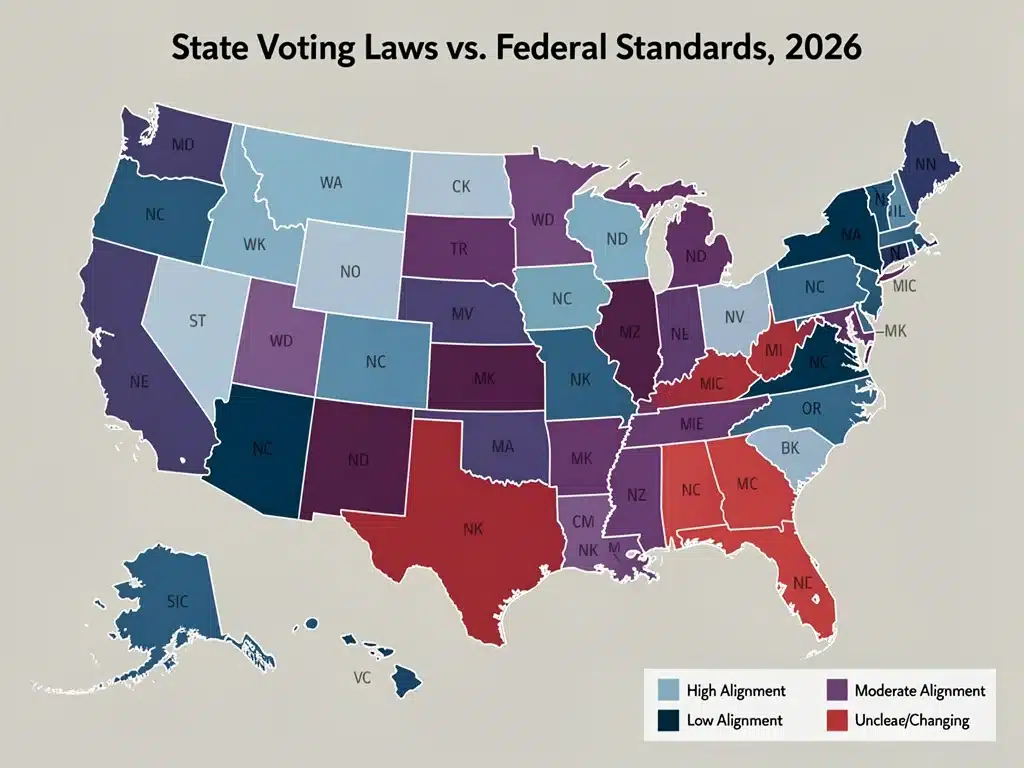
Conversely, states that have recently enacted more restrictive voting laws are likely to resist federal mandates vehemently. These states often argue that such legislation constitutes an unconstitutional overreach of federal power, infringing upon their reserved rights to manage elections. Their objections typically center on principles of states’ rights, concerns about unfunded mandates, and claims that federal standards may not be appropriate for their unique local contexts. This resistance could manifest in several ways:
- Legal Challenges: States might file lawsuits challenging the constitutionality of federal voting laws, arguing that they violate the Tenth Amendment or other provisions limiting federal authority.
- Non-Compliance or Delays: Some states might attempt to circumvent or delay the implementation of federal mandates, creating friction with federal enforcement agencies.
- Counter-Legislation: In response to federal action, states could pass their own laws designed to either mitigate the impact of federal mandates or to further assert state control over election processes.
The potential for legal battles is particularly high. The Supreme Court has historically played a significant role in defining the boundaries of federal and state power in election administration. Any new federal legislation would almost certainly face judicial scrutiny, with the outcomes potentially reshaping the legal framework for voting rights for decades to come. These legal challenges could create significant uncertainty, making it difficult for election officials to plan and implement changes in the run-up to 2026.
Moreover, political polarization exacerbates these state responses. Voting rights have become a highly partisan issue, meaning that state reactions to federal legislation will often align with the dominant political party in power within that state. This partisan divide can make compromise difficult and amplify conflicts, potentially leading to a patchwork of compliance and resistance across the nation, even in the face of federal law.
In conclusion, state responses to federal voting rights legislation will be diverse, ranging from full cooperation to staunch resistance and legal challenges. This dynamic will underscore the ongoing tension between federal authority and state sovereignty in election administration, profoundly influencing the practical implementation of any new laws by 2026.
Impacts on Voter Access and Participation
The primary objective of many federal voting rights proposals is to enhance voter access and participation, particularly for historically marginalized communities. If successfully enacted, these laws could significantly reshape who votes, how they vote, and the overall demographic composition of the electorate in 2026. The impacts, however, would not be uniform across all states and demographic groups, leading to both anticipated gains and potential new challenges.
One of the most direct impacts of federal legislation mandating expanded access would be a likely increase in voter registration. Provisions such as automatic voter registration or same-day registration have been shown in various studies to boost registration rates, especially among younger voters and those who move frequently. A larger registered electorate could translate into higher overall turnout, assuming these newly registered voters are also mobilized to cast their ballots.
Key Areas of Potential Impact
Federal intervention could significantly alter several aspects of voter access and participation:
- Increased Registration: Automatic and same-day registration provisions could add millions of eligible voters to the rolls, particularly among younger and mobile populations.
- Reduced Barriers for Specific Groups: Standardized early voting, no-excuse absentee voting, and reforms to voter ID laws could disproportionately benefit working-class individuals, elderly voters, and minority communities who often face greater hurdles to in-person voting on Election Day.
- Enhanced Voter Education: Federal mandates might also include provisions for improved voter education campaigns, ensuring citizens are better informed about their rights and the voting process.
Moreover, federal standards for early voting and mail-in balloting could make voting more convenient for a broader segment of the population. Individuals with demanding work schedules, childcare responsibilities, or mobility issues often find it difficult to vote on a single Election Day. Expanding options like extensive early voting periods and universal mail-in ballots could alleviate these logistical barriers, potentially leading to higher participation rates among these groups. This could be particularly impactful in states that currently offer limited options for early or absentee voting.
However, increased access alone does not guarantee increased participation. Voter turnout is influenced by a multitude of factors, including political mobilization, the competitiveness of elections, and public trust in the electoral system. While federal legislation can address structural barriers, it may not fully overcome issues related to voter apathy or cynicism. Furthermore, if federal laws are met with significant state resistance or legal challenges, the resulting confusion and uncertainty could inadvertently suppress turnout, at least in the short term, as voters and election officials navigate new and potentially contested rules.
The impact on specific demographic groups is also a critical consideration. Historically, restrictive voting laws have disproportionately affected minority communities, low-income individuals, and students. Federal legislation designed to dismantle these barriers could lead to a more representative electorate. However, the exact extent of this impact will depend on the specific provisions of the law, the effectiveness of its implementation, and the ongoing efforts of advocacy groups to educate and mobilize voters.
In conclusion, federal voting rights legislation in 2026 aims to boost voter access and participation, potentially increasing registration and making voting more convenient for many. However, the ultimate impact will depend on effective implementation, public trust, and the ability to overcome state resistance and political challenges.
Election Administration and Resource Allocation
The implementation of any significant federal voting rights legislation in 2026 would undoubtedly have profound implications for election administration at the state and local levels. Election officials, already operating under tight budgets and often facing intense scrutiny, would need to adapt to new mandates, potentially requiring substantial changes in operational procedures, technology, and resource allocation. This shift could present both opportunities for modernization and significant logistical challenges.
One of the most immediate impacts would be on funding. Federal legislation that imposes new requirements, such as expanded early voting sites, updated voter registration systems, or enhanced cybersecurity measures, would likely necessitate increased financial investment. While some federal proposals include funding mechanisms to assist states, the extent of this financial support is often a point of contention. States and localities would need to assess whether federal grants are sufficient to cover the costs of compliance, or if they would be left to bear a significant portion of the burden, potentially straining already limited local budgets.

Operational Changes and Staffing Needs
New federal mandates would require substantial operational adjustments for election administrators:
- Technology Upgrades: Implementing automatic voter registration or secure online voting portals would demand significant investment in new software, hardware, and IT infrastructure.
- Staff Training: Election workers, both paid and volunteer, would require extensive training on new procedures, voter ID requirements, and ballot handling protocols.
- Polling Place Logistics: Expanded early voting or changes to polling place accessibility would necessitate adjustments to location scouting, staffing, and equipment deployment.
Beyond funding, federal legislation could drive technological modernization. Mandates for secure online voter registration portals, updated election management systems, or more robust cybersecurity defenses could push states to adopt cutting-edge technologies. While this could enhance efficiency and security in the long run, the initial transition period might be fraught with technical complexities and the need for specialized expertise that many local election offices currently lack. Training for election staff and volunteers on new systems and procedures would also become a critical, and potentially costly, undertaking.
Furthermore, changes to voting methods could alter the demand for election personnel and infrastructure. For instance, a shift towards universal mail-in voting might reduce the need for numerous physical polling places but would increase the demand for ballot printing, mailing, and processing facilities. Conversely, mandates for extended early voting periods would require more early voting sites, longer hours, and a larger pool of trained poll workers. These logistical shifts require careful planning and resource allocation to avoid disruptions and ensure smooth election operations.
The potential for federal preemption of certain state laws also looms large. If federal legislation sets minimum standards that supersede existing state regulations, election officials would be compelled to change established practices. This could create friction with state legislatures that prefer to maintain their current systems, leading to administrative confusion and, in some cases, outright defiance. The clarity and specificity of federal mandates will be crucial in minimizing such conflicts and providing clear guidance to administrators.
In conclusion, federal voting rights legislation in 2026 will heavily influence election administration, demanding significant resource allocation for funding, technology upgrades, and staff training. The success of these changes hinges on adequate federal support and clear mandates to navigate potential state-level resistance and operational complexities.
The Role of Advocacy Groups and Public Opinion
The trajectory of voting rights legislation in 2026 will not solely be determined by political maneuvering within legislative chambers; it will also be profoundly shaped by the persistent efforts of advocacy groups and the evolving landscape of public opinion. These external forces play a critical role in framing the debate, mobilizing support or opposition, and ultimately influencing the political will necessary for legislative action or resistance. Understanding their impact is key to grasping the full picture of the future of voting rights.
Advocacy groups on both sides of the political spectrum are highly engaged in the voting rights debate. Organizations dedicated to expanding voter access, such as the ACLU, League of Women Voters, and numerous civil rights groups, will continue to lobby lawmakers, educate the public, and challenge restrictive laws in court. Their efforts often involve grassroots organizing, voter registration drives, and public awareness campaigns designed to highlight the importance of voting and the potential barriers that exist. These groups play a crucial role in bringing personal stories and real-world impacts to the legislative discussion.
How External Factors Influence Legislation
External pressures from advocacy and public sentiment are not merely background noise; they actively shape policy debates:
- Public Pressure: Organized advocacy campaigns can generate significant public pressure on elected officials, making it politically costly to ignore or oppose popular voting reforms.
- Legal Challenges: Advocacy groups are often at the forefront of challenging state and federal voting laws in court, shaping the legal interpretations and precedents that govern elections.
- Voter Education and Mobilization: These groups play an indispensable role in informing citizens about their rights and facilitating their participation, regardless of legislative changes.
Conversely, groups that advocate for stricter election security measures or oppose federal intervention also wield significant influence. Organizations aligned with conservative principles often emphasize the need to prevent voter fraud and protect the integrity of elections, sometimes arguing that expanded access measures can compromise security. Their strategies include lobbying, public relations campaigns, and supporting legal challenges against what they perceive as overreaching federal or state laws. The clash between these opposing advocacy efforts often defines the intensity and direction of the national conversation.
Public opinion, while sometimes volatile, can also exert considerable pressure. Polling data often reveals broad support for certain aspects of voting access, such as early voting, while opinions on other issues, like voter ID laws, can be more divided along partisan lines. Lawmakers are typically sensitive to public sentiment, especially as elections approach. A significant shift in public opinion on voting rights, perhaps driven by major events or sustained advocacy, could force politicians to reconsider their stances or prioritize certain legislative actions.
Furthermore, the media plays a pivotal role in shaping both public opinion and the effectiveness of advocacy efforts. News coverage, editorials, and investigative journalism can amplify the voices of advocacy groups, inform the public about proposed legislation, and expose issues related to voter access or election security. The way these issues are framed in the media can significantly influence how the public perceives the urgency and importance of voting rights reform.
Ultimately, the interplay between well-organized advocacy campaigns, shifting public sentiment, and media discourse will be a powerful determinant of how federal legislation progresses and how states respond. By 2026, these external forces will continue to exert pressure on lawmakers to address the fundamental questions surrounding the nation’s democratic processes.
In summary, advocacy groups and public opinion are crucial in shaping the future of voting rights in 2026. Their collective pressure, legal challenges, and educational initiatives influence legislative priorities and state responses, underscoring their indispensable role in the ongoing debate.
Looking Ahead: The 2026 Election Cycle and Beyond
As the United States progresses towards the 2026 election cycle, the foundational changes in voting rights, whether through federal legislation or ongoing state-level reforms, will undoubtedly have a tangible impact on the democratic process. This period will serve as a crucial testbed for any new laws, revealing their effectiveness, unintended consequences, and the resilience of the electoral system under new conditions. The landscape of voting in 2026 will not only reflect legislative outcomes but also societal shifts and technological advancements.
One of the most immediate effects will be seen in voter registration and turnout rates. If federal laws successfully expand access, 2026 could witness a more diverse and engaged electorate. Election administrators will be tasked with implementing these new rules, which will require significant training, technological updates, and public outreach. The efficiency and fairness with which these changes are rolled out will largely determine public confidence in the election outcomes. Any significant logistical hiccups or perceived biases could fuel distrust, regardless of the legislative intent.
Furthermore, the 2026 elections will likely be a battleground for ongoing legal challenges. Even if federal legislation passes, its constitutionality will almost certainly be tested in the courts, potentially leading to injunctions or modifications that could alter the rules of the game even as elections are underway. This legal uncertainty could create confusion for voters and election officials alike, underscoring the need for clear communication and robust legal defense of any new federal mandates.
Key Considerations for the 2026 Cycle
Several factors will be paramount in determining the success and impact of voting rights in 2026:
- Judicial Review: The Supreme Court and lower federal courts will play a critical role in interpreting and potentially upholding or striking down new federal and state voting laws.
- Technological Adaptation: The integration of new voting technologies, from registration systems to ballot counting, will be a key operational challenge and opportunity.
- Voter Education: Effective public information campaigns will be essential to ensure voters understand any new rules and feel confident participating.
Beyond the immediate election cycle, the discussions around voting rights in 2026 will also influence long-term trends in American democracy. The legislative outcomes could either solidify a more uniform national standard for elections or further entrench the existing state-centric fragmentation. This will have implications for everything from federal funding for elections to the partisan balance of power in future elections. The precedents set in 2026 could shape the political strategies and electoral dynamics for years to come.
The role of technology will also continue to evolve. Discussions around online voting, blockchain-secured election systems, and AI-driven voter outreach will likely gain prominence. While not central to current federal legislation, the technological landscape will undoubtedly influence future debates on accessibility, security, and the very nature of democratic participation. The decisions made in the lead-up to 2026 will lay the groundwork for how these emerging technologies are integrated into the electoral process.
In conclusion, the 2026 election cycle will be a critical juncture for voting rights, testing new federal and state laws, and revealing their practical impacts on voter participation and election administration. Ongoing legal battles and technological integration will further shape the long-term trajectory of American democracy, underscoring the enduring importance of this foundational issue.
| Key Aspect | Brief Description |
|---|---|
| Federal Legislation | Proposed laws aim to standardize voting access, registration, and security across all states by 2026. |
| State Impacts | Diverse state responses range from cooperation to legal challenges, affecting local election administration. |
| Voter Access | Potential for increased voter registration and participation, particularly among marginalized groups, through expanded options. |
| Election Administration | New mandates could require significant funding, technology upgrades, and staff training for local election offices. |
Frequently Asked Questions About Voting Rights in 2026
The primary goals include standardizing voter access across states, expanding registration options like automatic and same-day registration, ensuring minimum early voting periods, and enhancing election security measures to build public confidence in the electoral process nationwide.
State reactions will vary significantly, ranging from full cooperation and alignment with federal standards to strong resistance, potential non-compliance, and legal challenges based on arguments of states’ rights and constitutional overreach, creating a complex implementation landscape.
Federal legislation expanding access is expected to increase voter registration and potentially participation, especially for historically disenfranchised groups. However, actual turnout also depends on political mobilization, election competitiveness, and public trust, which can be affected by legal disputes.
Election administrators face challenges including securing adequate funding for new requirements, upgrading technology, training staff on updated procedures, and adapting logistical operations for expanded voting options. Clear federal guidance and sufficient resources are crucial for smooth implementation.
Advocacy groups are instrumental in shaping the debate by lobbying lawmakers, educating the public, mobilizing voters, and initiating legal challenges. Their efforts help frame public opinion and exert pressure on politicians, significantly influencing the direction of voting rights reform.
Conclusion
The journey towards 2026 reveals a critical juncture for American democracy, where the future of voting rights hangs in the balance between federal aspirations for uniformity and state-level autonomy. Proposed federal legislation, aimed at expanding access and standardizing election practices, offers the promise of a more inclusive and equitable electoral system. However, the path to implementation is fraught with challenges, including potential state resistance, complex legal battles, and the intricate logistical demands placed upon election administrators. The active engagement of advocacy groups and the evolving currents of public opinion will continue to exert significant influence, shaping both legislative outcomes and the practical realities of voting. Ultimately, the success of these efforts by 2026 will not only define voter access for a generation but also reaffirm the fundamental principles of American democratic governance, ensuring that the voice of every eligible citizen can be heard.