Rapid Prototyping with Low-Code for U.S. Teams in 2026

Rapid prototyping with low-code platforms is revolutionizing how U.S. teams develop and deploy applications, offering unparalleled speed and efficiency in 2026, empowering businesses to quickly validate ideas, iterate on designs, and bring solutions to market faster than ever before.
In the fast-evolving digital landscape of 2026, the ability to transform ideas into functional applications with unprecedented speed is not just an advantage—it’s a necessity. From Concept to Code: A 2026 Guide to Rapid Prototyping with Low-Code Platforms for U.S. Teams (PRACTICAL SOLUTIONS) explores how low-code development is empowering U.S. organizations to innovate faster, reduce development cycles, and meet dynamic market demands effectively. This guide delves into practical strategies and insights for leveraging low-code to streamline your prototyping process.
Understanding the low-code revolution for U.S. businesses
The low-code revolution is fundamentally changing how U.S. businesses approach software development. By minimizing manual coding and maximizing visual interfaces, these platforms enable a broader range of individuals, including business analysts and citizen developers, to contribute to the application creation process. This shift democratizes development, making it more accessible and significantly faster.
In 2026, low-code is no longer a niche tool but a mainstream technology adopted across various industries in the United States. Its appeal lies in its promise to bridge the gap between business needs and IT capacity, allowing companies to respond to market changes with agility. This section explores the core tenets of low-code and why it’s become indispensable for rapid prototyping.
The essence of low-code development
Low-code platforms provide a graphical interface for building applications, abstracting away much of the underlying code. Users can drag and drop pre-built components, configure workflows, and integrate with existing systems through visual tools. This approach drastically reduces the time and specialized skills required to develop software.
- Visual development: Drag-and-drop interfaces accelerate UI/UX design.
- Pre-built components: Reusable modules for common functionalities save time.
- Automated workflows: Streamline business processes with visual flowcharts.
- Integration capabilities: Connect easily with existing enterprise systems.
Why rapid prototyping demands low-code
Traditional development cycles can be lengthy, often delaying critical feedback loops and market entry. Low-code platforms, however, are inherently designed for speed and iteration, making them ideal for rapid prototyping. They allow U.S. teams to quickly build functional prototypes, gather user feedback, and make necessary adjustments in a fraction of the time.
This rapid iteration capability is crucial for validating ideas early, minimizing risk, and ensuring that the final product truly meets user needs. It transforms the development process into a continuous cycle of experimentation and refinement, aligning perfectly with agile methodologies. The ability to quickly pivot based on feedback is a game-changer for competitive U.S. markets.
In conclusion, the low-code revolution is not just about writing less code; it’s about fostering a more collaborative, efficient, and responsive development environment. For U.S. businesses, embracing low-code for rapid prototyping in 2026 means staying ahead of the curve and driving innovation from concept to code at an accelerated pace.
Selecting the right low-code platform for U.S. teams
Choosing the appropriate low-code platform is a critical decision for U.S. teams aiming to excel in rapid prototyping. The market is saturated with various options, each offering unique strengths and features. A careful evaluation based on specific organizational needs, integration requirements, and scalability is essential to ensure long-term success. This section outlines key considerations for making an informed choice.
The platform you select will significantly impact your team’s efficiency, the quality of your prototypes, and your ability to scale. It’s not just about the immediate prototyping needs but also about how the platform supports full-scale application deployment and ongoing maintenance. U.S. companies must look beyond basic functionalities to assess the true value proposition.
Key evaluation criteria
When assessing low-code platforms, several factors should guide your decision. Compatibility with existing IT infrastructure, security features, and vendor support are paramount. Furthermore, the platform’s ability to handle complex business logic and integrate with diverse data sources is crucial for robust prototyping.
- Scalability: Can the platform grow with your business needs?
- Integration: How well does it connect with your current systems (CRMs, ERPs, databases)?
- Security: Does it meet industry standards and compliance requirements?
- User-friendliness: Is it intuitive for both professional developers and citizen developers?
- Cost-effectiveness: Evaluate licensing models, maintenance, and potential hidden costs.
- Vendor support and community: Access to resources, documentation, and a strong user community.
Platform types and their best use cases
Low-code platforms can be broadly categorized based on their primary focus. Some are ideal for simple departmental applications, while others are designed for enterprise-grade solutions. Understanding these distinctions helps U.S. teams match a platform to their specific project requirements.
For instance, platforms focused on process automation might be perfect for streamlining internal workflows, whereas those emphasizing customer-facing applications will offer more robust UI/UX design capabilities. Identifying your primary use case will narrow down the options considerably. Consider whether your team needs to build web apps, mobile apps, or integrate complex backend services.
Ultimately, selecting the right low-code platform involves a thorough analysis of your organization’s unique context. It’s about finding a tool that not only facilitates rapid prototyping but also aligns with your strategic objectives and technological ecosystem. A well-chosen platform will empower U.S. teams to unlock their full innovation potential.
Strategic implementation of low-code for rapid prototyping
Implementing low-code platforms for rapid prototyping requires a strategic approach beyond simply adopting the technology. For U.S. teams, this involves establishing clear objectives, defining roles, and integrating low-code into existing development methodologies. A well-thought-out implementation plan ensures that the benefits of low-code are fully realized, leading to efficient and effective prototype creation.
The transition to a low-code-centric prototyping model should be gradual and well-managed. It’s not just about tool adoption, but also about cultural shifts within the development team and the broader organization. Successful implementation hinges on clear communication, proper training, and continuous support.
Defining clear objectives and scope
Before embarking on any low-code prototyping project, U.S. teams must clearly define what they aim to achieve. What problem is the prototype solving? What are the key functionalities to be tested? Establishing a precise scope prevents scope creep and ensures that development efforts remain focused.
A well-defined objective also helps in measuring the success of the prototype. Is it meant to validate a concept, test user experience, or gather feedback on specific features? Understanding the prototype’s purpose guides the entire development process. This clarity is especially important in a rapid prototyping environment where iterations are frequent.
Integrating low-code into agile and DevOps practices
Low-code platforms naturally complement agile and DevOps methodologies due to their emphasis on speed and iteration. For U.S. teams, integrating low-code into these existing practices can significantly enhance productivity and collaboration. This involves incorporating low-code development into sprints, continuous integration, and continuous deployment pipelines.

By leveraging low-code within an agile framework, teams can accelerate feedback loops and adapt to changes more quickly. DevOps principles, such as automation and collaboration, further amplify the benefits of low-code by streamlining the deployment and management of prototypes.
- Shortened sprints: Low-code enables faster feature delivery within agile sprints.
- Continuous integration/deployment: Automate testing and deployment of prototypes.
- Cross-functional collaboration: Empower diverse teams to contribute to development.
- Iterative feedback cycles: Rapidly incorporate user and stakeholder input.
In summary, strategic implementation of low-code for rapid prototyping goes beyond tool selection. It involves a holistic approach that aligns technology with business objectives, integrates with established development practices, and fosters a culture of continuous innovation within U.S. organizations. This comprehensive strategy ensures that low-code delivers its full potential.
Best practices for rapid prototyping with low-code in 2026
To truly harness the power of low-code for rapid prototyping, U.S. teams must adhere to a set of best practices. These practices are designed to maximize efficiency, ensure quality, and accelerate the journey from concept to a validated solution. In 2026, where speed and adaptability are paramount, adopting these guidelines is essential for competitive advantage.
Effective rapid prototyping with low-code isn’t just about building fast; it’s about building smart. This means focusing on user needs, maintaining a clear vision, and leveraging the platform’s capabilities to their fullest. This section provides actionable advice for optimizing your low-code prototyping efforts.
Focus on user experience (UX) from the start
Even in a rapid prototyping environment, user experience should never be an afterthought. Low-code platforms allow for quick iterations on UI/UX designs, making it easier to gather feedback and refine the user journey early in the process. Prioritizing UX ensures that the prototype is not only functional but also intuitive and engaging for its intended users.
Conducting user testing with even basic prototypes can reveal critical insights and prevent costly redesigns later on. U.S. teams should use low-code’s flexibility to experiment with different layouts, navigation flows, and interactive elements, continuously improving the user experience based on real-world feedback.
Iterate quickly and embrace feedback
The core strength of rapid prototyping with low-code lies in its iterative nature. U.S. teams should aim for frequent, small iterations rather than waiting for a perfect product. Each iteration provides an opportunity to test assumptions, gather feedback, and refine the prototype. This continuous cycle of build-measure-learn is crucial for successful innovation.
Embracing feedback, even critical feedback, is vital. Low-code platforms make it relatively easy to implement changes based on user input, allowing teams to quickly pivot and improve their prototypes. This agility ensures that the final product is robust and aligned with market demands.
- Short iteration cycles: Aim for daily or weekly updates to prototypes.
- Regular user testing: Involve end-users throughout the prototyping process.
- Open communication: Foster a culture where feedback is encouraged and acted upon.
- Version control: Manage different prototype versions effectively to track changes.
By following these best practices, U.S. teams can elevate their rapid prototyping efforts with low-code. The emphasis on user experience, quick iteration, and continuous feedback ensures that prototypes are not just built fast, but built right, paving the way for successful application development and deployment.
Overcoming common challenges in low-code prototyping
While low-code platforms offer significant advantages for rapid prototyping, U.S. teams may encounter specific challenges during implementation. Addressing these hurdles proactively is crucial for maximizing the benefits of low-code and ensuring successful project outcomes. This section explores common obstacles and provides practical solutions for overcoming them.
From potential vendor lock-in to managing technical debt, understanding these challenges allows organizations to develop strategies that mitigate risks and maintain the long-term viability of their low-code initiatives. Preparation and foresight are key to navigating the complexities of low-code development in 2026.
Managing vendor lock-in concerns
One common concern with low-code platforms is the potential for vendor lock-in. Once a significant investment has been made in a particular platform, migrating to another can be costly and complex. U.S. teams can mitigate this risk by carefully evaluating platform portability and data export capabilities during the selection phase.
Choosing platforms that adhere to open standards and offer robust API integration options can also reduce dependency on a single vendor. Additionally, maintaining clear documentation of the application’s architecture, even with low-code, helps in understanding its components and potential migration paths.
Addressing scalability and performance
While low-code platforms are excellent for rapid prototyping, concerns about scalability and performance often arise when prototypes evolve into full-scale applications. U.S. teams should ensure their chosen platform can handle increased user loads and complex data transactions without compromising performance. This requires careful planning and potentially leveraging hybrid approaches.
Some low-code platforms are designed with enterprise-grade scalability in mind, offering features like cloud-native deployment, microservices architecture, and robust database management. Performance testing throughout the prototyping phase can also identify potential bottlenecks early on, allowing for optimization before full deployment.
Balancing speed with governance and security
The speed of low-code development can sometimes lead to overlooking critical aspects of governance and security. For U.S. organizations, maintaining compliance and protecting sensitive data is non-negotiable. It’s essential to integrate security best practices and governance policies into the low-code development lifecycle from the outset.
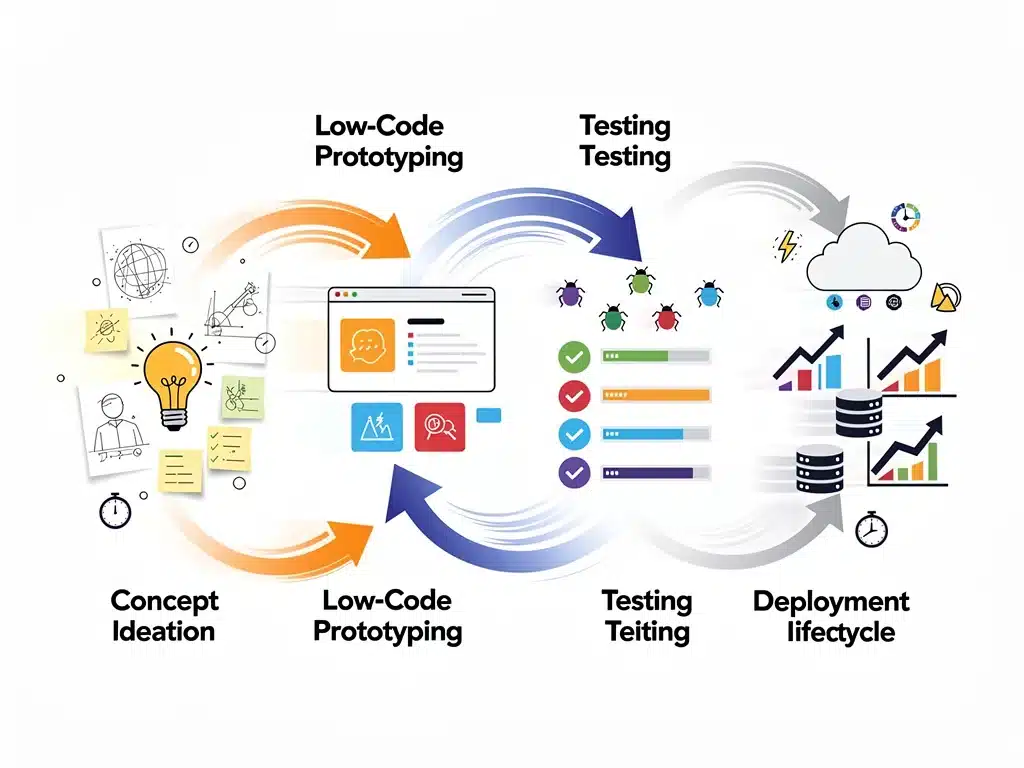
This includes implementing access controls, conducting regular security audits, and ensuring that all applications meet regulatory requirements. Low-code platforms often come with built-in security features, but teams must actively configure and manage them to maintain a secure environment.
- Platform due diligence: Thoroughly vet platforms for security certifications and compliance.
- Defined governance policies: Establish clear rules for low-code development and deployment.
- Security by design: Embed security considerations from the initial prototyping phase.
- Regular audits: Conduct security and compliance audits of low-code applications.
By proactively addressing these common challenges, U.S. teams can unlock the full potential of low-code for rapid prototyping, ensuring that their innovative solutions are not only developed quickly but are also scalable, secure, and sustainable in the long run.
The future of rapid prototyping: low-code trends for 2026 and beyond
As we look beyond 2026, the landscape of rapid prototyping with low-code platforms is poised for continuous evolution. Emerging technologies and changing market demands will shape the next generation of low-code capabilities, offering even more sophisticated tools for U.S. teams. Understanding these trends is crucial for staying competitive and leveraging future innovations.
The convergence of artificial intelligence, machine learning, and advanced automation with low-code is set to redefine what’s possible in application development. These advancements promise to further accelerate prototyping, making it more intelligent, predictive, and personalized. This section explores the exciting future of low-code.
AI-powered low-code development
Artificial intelligence is increasingly being integrated into low-code platforms, promising to make development even faster and smarter. AI-powered capabilities can assist with everything from suggesting optimal UI designs to automating code generation based on natural language descriptions. This will allow U.S. teams to create highly sophisticated prototypes with minimal manual effort.
Imagine a low-code platform that learns from your previous projects, predicts your next steps, and even helps debug your applications. These intelligent assistants will empower developers to focus on higher-level problem-solving and innovation, further reducing development time and improving code quality. The synergy between AI and low-code is a powerful combination.
Hyperautomation and intelligent process automation
The trend towards hyperautomation, which involves orchestrating multiple technologies to automate processes end-to-end, will significantly impact low-code prototyping. Low-code platforms will play a central role in building the interfaces and logic for these automated workflows, allowing U.S. teams to prototype complex intelligent process automation (IPA) solutions rapidly.
This means not just automating individual tasks but entire business processes, from data entry to decision-making. Low-code’s visual nature makes it an ideal tool for designing, testing, and deploying these intricate automation sequences, enabling businesses to achieve unprecedented operational efficiency.
Increased focus on mobile-first and edge computing
With the proliferation of mobile devices and the rise of edge computing, low-code platforms will continue to prioritize mobile-first development. U.S. teams will increasingly use low-code to prototype applications that perform optimally on various devices and leverage data processing capabilities at the network edge. This trend is driven by the demand for real-time data and localized processing.
- Responsive design: Low-code tools will offer more advanced features for multi-device compatibility.
- Offline capabilities: Enhanced support for applications that function without constant internet connectivity.
- Edge data integration: Seamless connectivity with edge devices and sensors for real-time insights.
- Augmented reality (AR) integration: Emerging low-code components for AR experiences.
The future of rapid prototyping with low-code is bright, characterized by increased intelligence, automation, and adaptability. U.S. teams that embrace these evolving trends will be well-positioned to innovate at the forefront of technology, continuously transforming concepts into powerful, market-ready solutions.
Measuring success: KPIs for low-code rapid prototyping
To truly understand the impact of low-code rapid prototyping, U.S. teams must establish clear Key Performance Indicators (KPIs). These metrics provide objective measures of efficiency, effectiveness, and return on investment, guiding continuous improvement and demonstrating the value of low-code initiatives. Without proper measurement, it’s difficult to assess success or identify areas for optimization.
Effective KPIs go beyond simple completion rates. They delve into the quality of the prototypes, the speed of iteration, the reduction in development costs, and ultimately, the business value generated. This section outlines essential KPIs for evaluating your low-code rapid prototyping efforts in 2026.
Development cycle time reduction
One of the primary benefits of low-code is its ability to accelerate development. A key KPI is the reduction in development cycle time, specifically the time taken from concept ideation to a functional prototype. U.S. teams should track how much faster they can deliver prototypes compared to traditional coding methods.
This metric can be broken down further to include the time spent on specific phases, such as design, build, and initial testing. A significant reduction in these timelines directly translates to faster market entry and a quicker validation of new ideas, which is crucial in competitive U.S. markets.
Cost savings and resource optimization
Low-code platforms are often touted for their cost-saving potential. KPIs related to cost savings should include reduced development costs (due to less specialized labor and faster build times), lower maintenance costs, and optimized resource allocation. U.S. teams should quantify the financial benefits derived from using low-code for prototyping.
This might involve comparing the cost of building a prototype with low-code versus traditional development, or tracking the number of developer hours saved. Resource optimization can be measured by how effectively existing team members are utilized, potentially empowering non-technical staff to contribute to development.
Prototype-to-production conversion rate
A critical measure of success for rapid prototyping is the conversion rate of prototypes into full production applications. While not all prototypes are meant for production, a higher conversion rate indicates that the prototyping process is effectively validating viable solutions. U.S. teams should track how many low-code prototypes successfully transition to a production environment.
- Faster time-to-market: Measure how quickly validated prototypes reach end-users.
- User adoption rates: Track how well production applications are adopted by their target audience.
- Feedback incorporation: Evaluate how effectively user feedback from prototypes is integrated into final products.
- Reduced rework: Quantify the decrease in major changes required post-prototyping.
By diligently tracking these KPIs, U.S. teams can gain a clear understanding of the value low-code rapid prototyping brings to their organization. These metrics not only justify investments in low-code but also provide actionable insights for continuous improvement and strategic decision-making.
Preparing your U.S. team for low-code adoption in 2026
Successfully integrating low-code rapid prototyping into a U.S. organization in 2026 requires more than just acquiring the technology; it demands a comprehensive approach to team preparation. This involves training, cultural shifts, and fostering a collaborative environment where both professional developers and citizen developers can thrive. A well-prepared team is the cornerstone of effective low-code adoption.
The success of low-code initiatives largely depends on the people using the platforms. Investing in training and creating a supportive ecosystem ensures that your team can fully leverage the capabilities of low-code, transforming the way applications are conceptualized, built, and deployed. This section provides practical steps for team readiness.
Training and upskilling initiatives
For professional developers, low-code platforms offer a way to accelerate their work and focus on more complex tasks. Training should focus on how to integrate low-code into existing development workflows, extend platform capabilities with custom code, and adhere to best practices for governance and security. This ensures they see low-code as an enabler, not a replacement.
For citizen developers (business users with little to no coding experience), training should focus on basic application design principles, understanding the low-code interface, and adhering to organizational guidelines. Empowering these individuals expands the development capacity of the organization significantly.
- Customized training programs: Tailor courses for different skill levels and roles.
- Certification programs: Encourage team members to get certified on chosen low-code platforms.
- Mentorship opportunities: Pair experienced developers with citizen developers.
- Continuous learning: Provide access to resources and workshops for ongoing skill development.
Fostering a collaborative development culture
Low-code thrives in environments that promote collaboration between IT and business units. U.S. teams need to break down traditional silos and encourage cross-functional cooperation. This means creating shared goals, establishing clear communication channels, and recognizing the contributions of all team members, regardless of their technical background.
Workshops, hackathons, and joint project teams can help bridge the gap between business needs and technical solutions. When IT and business collaborate closely, prototypes are more likely to meet actual user requirements and achieve quicker acceptance. This synergy is vital for the success of any low-code initiative.
Establishing a low-code center of excellence (CoE)
For larger U.S. organizations, establishing a Low-Code Center of Excellence (CoE) can provide centralized governance, best practices, and support for all low-code initiatives. A CoE helps standardize development processes, ensure security compliance, and provide ongoing training and mentorship.
The CoE acts as a knowledge hub, sharing insights, templates, and reusable components across different teams. This ensures consistency, reduces duplication of effort, and accelerates the learning curve for new low-code users, ultimately driving widespread and effective adoption across the enterprise.
In conclusion, preparing your U.S. team for low-code adoption in 2026 is a strategic imperative. By investing in comprehensive training, fostering a collaborative culture, and considering a Low-Code CoE, organizations can ensure their teams are well-equipped to leverage low-code for rapid prototyping, driving innovation and achieving digital transformation goals.
| Key Aspect | Brief Description |
|---|---|
| Low-Code Definition | Visual development platforms minimizing manual coding for faster app creation. |
| Rapid Prototyping | Accelerated creation and iteration of functional prototypes to validate ideas quickly. |
| Key Benefits | Faster time-to-market, reduced costs, increased innovation, and enhanced collaboration. |
| Future Trends | AI integration, hyperautomation, and mobile-first development for low-code. |
Frequently asked questions about low-code rapid prototyping
Rapid prototyping with low-code platforms involves using visual development tools to quickly build functional versions of applications. This approach allows U.S. teams to test ideas, gather early feedback, and iterate on designs much faster than traditional coding methods, accelerating the entire development lifecycle.
Low-code benefits U.S. businesses by accelerating digital transformation, reducing development costs, and empowering citizen developers. It enables faster time-to-market for new applications, fosters innovation, and helps organizations remain agile in response to rapidly changing market demands and technological advancements in 2026.
Yes, many modern low-code platforms are designed to handle complex enterprise applications. They offer robust integration capabilities, scalability features, and advanced customization options. While some platforms are better suited for specific use cases, enterprise-grade low-code solutions can support sophisticated business logic and large-scale deployments.
Main challenges include potential vendor lock-in, ensuring scalability for production applications, and maintaining governance and security standards. U.S. teams must also manage the cultural shift between traditional IT and citizen developers, providing adequate training and establishing clear best practices for effective adoption.
Future trends impacting low-code prototyping include the integration of AI and machine learning for smarter development, hyperautomation for end-to-end process automation, and a continued focus on mobile-first and edge computing solutions. These advancements will make low-code even more powerful and versatile for U.S. teams.
Conclusion
The journey From Concept to Code: A 2026 Guide to Rapid Prototyping with Low-Code Platforms for U.S. Teams (PRACTICAL SOLUTIONS) reveals a transformative shift in software development. Low-code is no longer just a trend; it’s a fundamental pillar for innovation and agility in the competitive U.S. market. By embracing low-code, organizations can dramatically accelerate their prototyping cycles, reduce development costs, and empower a broader range of team members to contribute to application creation. The strategic selection of platforms, adherence to best practices, and proactive management of challenges are crucial for maximizing its benefits. As AI and automation continue to integrate with low-code, the future promises even greater efficiencies and capabilities, ensuring that U.S. businesses remain at the forefront of technological advancement and can consistently deliver high-value solutions with unprecedented speed and precision.