Edge AI Deployment: 4 Strategies for U.S. Enterprises in 2025

U.S. enterprises aiming for competitive advantage in real-time data processing must strategically embrace Edge AI deployment, integrating advanced analytics closer to data sources to optimize operations and accelerate decision-making effectively.
The landscape of enterprise technology is rapidly evolving, and at its forefront is the burgeoning field of Edge Artificial Intelligence. For U.S. enterprises, understanding and implementing effective Edge AI Deployment Strategies is no longer a luxury but a critical necessity for maintaining a competitive edge in the next 12 months. This insider’s guide delves into the core strategies that will define success in this transformative era.
Understanding Edge AI and Its Strategic Imperative
Edge AI refers to the deployment of artificial intelligence algorithms directly on edge devices, closer to the source of data generation, rather than relying solely on centralized cloud infrastructure. This paradigm shift brings significant advantages, particularly for U.S. enterprises dealing with vast amounts of data, stringent latency requirements, and concerns over data privacy and bandwidth costs. The strategic imperative for adopting Edge AI stems from its ability to enable real-time decision-making, enhance operational efficiency, and unlock new business models.
The move towards edge computing with integrated AI is driven by the sheer volume and velocity of data generated by IoT devices, smart sensors, and connected systems across various industries. Traditional cloud-centric approaches often struggle with the latency and bandwidth demands of processing all this data remotely. By bringing AI processing to the edge, organizations can analyze data instantaneously, reducing the time from insight to action and fostering a more agile and responsive operational environment. This localized processing also provides enhanced security and compliance benefits, a growing concern for many U.S. businesses.
The Shift from Cloud to Edge: Why Now?
The transition from a purely cloud-based AI model to a hybrid or fully edge-based one is accelerating due to several technological advancements and business pressures. Miniaturization of powerful processors, improved energy efficiency of AI chips, and the proliferation of 5G networks are making Edge AI more feasible and cost-effective than ever before. Enterprises are realizing that not all data needs to travel to the cloud for analysis, especially when immediate action is required.
- Reduced Latency: Critical for applications like autonomous vehicles, real-time manufacturing control, and patient monitoring.
- Lower Bandwidth Costs: Processing data locally significantly reduces the amount of data transmitted to the cloud, saving on network expenses.
- Enhanced Data Privacy: Sensitive data can be processed and stored locally, reducing exposure to external threats and aiding compliance with regulations.
- Improved Reliability: Edge systems can operate effectively even with intermittent or no connectivity to the central cloud.
The strategic imperative for U.S. enterprises to explore and implement Edge AI is clear. It promises not just incremental improvements but foundational shifts in how businesses operate, innovate, and compete. Over the next year, those who strategically integrate Edge AI will likely see significant gains in efficiency, security, and market responsiveness.
Strategy 1: Phased Rollout with Pilot Projects
One of the most prudent Edge AI Deployment Strategies for U.S. enterprises is a phased rollout, commencing with carefully selected pilot projects. This approach allows organizations to test the waters, understand the complexities, and refine their implementation strategies on a smaller scale before committing to a full-scale deployment. It mitigates risk, provides valuable learning experiences, and builds internal expertise.
Starting small enables teams to identify potential challenges related to hardware, software integration, data management, and operational workflows without disrupting core business functions. A successful pilot project can serve as a powerful internal case study, demonstrating the tangible benefits of Edge AI and garnering wider organizational buy-in. This gradual expansion ensures that the organization can adapt and optimize its approach based on real-world feedback and performance metrics.
Identifying Ideal Pilot Candidates
Choosing the right pilot project is crucial for the success of this strategy. Ideal candidates are often areas where latency is a critical factor, data privacy is paramount, or where existing cloud solutions are proving to be cost-prohibitive due to bandwidth requirements. Manufacturing lines, retail stores, and remote infrastructure monitoring are prime examples.
- Manufacturing Quality Control: Real-time defect detection using computer vision on the edge.
- Smart Retail Analytics: In-store customer behavior analysis without transmitting sensitive video to the cloud.
- Predictive Maintenance: Monitoring machinery in remote locations to predict failures locally.
- Healthcare Monitoring: Processing patient data on-device for immediate alerts and privacy.
By focusing on these high-impact, manageable projects, enterprises can quickly demonstrate ROI and build confidence in their Edge AI capabilities. The insights gained from these initial deployments are invaluable for scaling up and applying lessons learned to broader initiatives. This methodical approach minimizes disruption and maximizes the chances of long-term success.
Strategy 2: Leveraging Hybrid Cloud-Edge Architectures
Another powerful Edge AI Deployment Strategy involves adopting a hybrid cloud-edge architecture. This approach recognizes that not all AI workloads are suited for the edge, and a balanced strategy often yields the best results. Hybrid models combine the localized processing power of edge devices with the scalability, storage capacity, and advanced training capabilities of centralized cloud platforms.
In a hybrid setup, the edge handles immediate, time-sensitive tasks and pre-processes data, sending only relevant or aggregated information to the cloud for deeper analysis, model retraining, or long-term storage. This optimizes resource utilization, ensuring that each component of the architecture is used for its most suitable function. For U.S. enterprises, this means achieving the benefits of real-time edge intelligence while still leveraging the robust infrastructure and advanced services offered by major cloud providers.
Optimizing Data Flow and Model Management
Effective implementation of a hybrid architecture requires careful planning of data flow and sophisticated model management. Edge devices need to be capable of running inference locally, while the cloud acts as the central hub for model development, training, and deployment updates to the edge. This creates a continuous feedback loop that ensures edge models remain accurate and performant.
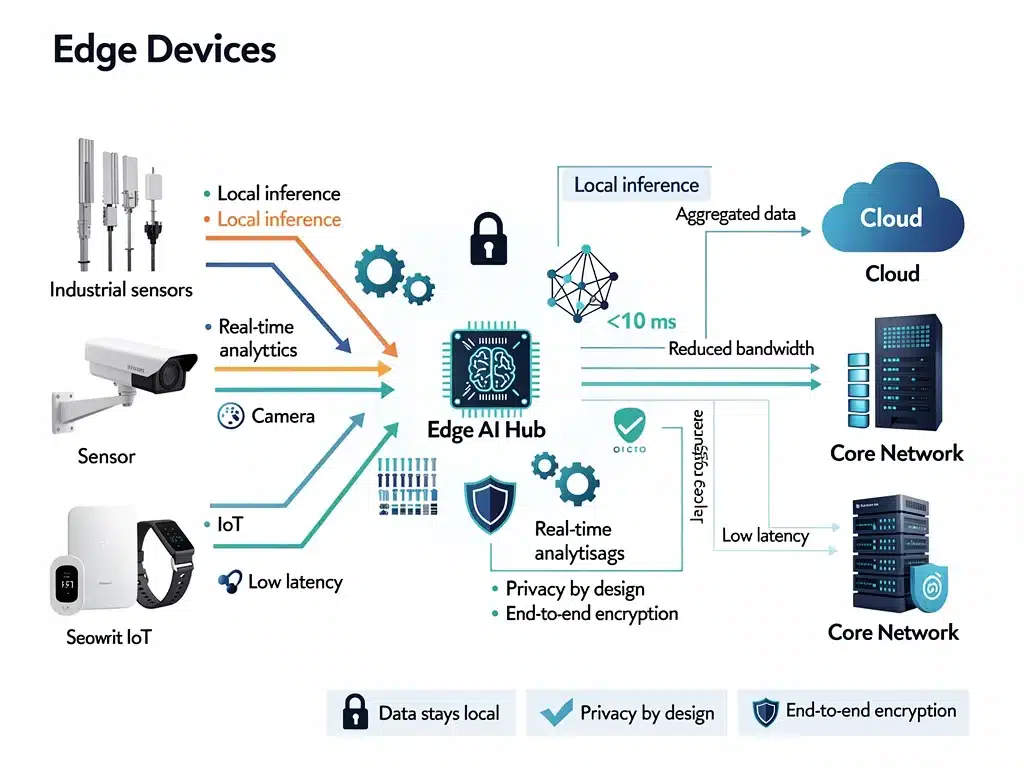
Consider the following aspects for optimizing your hybrid strategy:
- Data Filtering at the Edge: Only send critical or pre-processed data to the cloud, reducing bandwidth and storage costs.
- Distributed Model Training: Train models in the cloud with vast datasets, then deploy optimized, smaller versions to the edge for inference.
- Over-the-Air (OTA) Updates: Implement robust mechanisms for securely updating edge AI models and software remotely.
- Centralized Monitoring: Maintain a central view of all edge deployments for performance monitoring, troubleshooting, and security.
By strategically distributing AI workloads, U.S. enterprises can achieve a resilient, scalable, and cost-effective AI infrastructure. This hybrid approach allows businesses to capitalize on the strengths of both edge and cloud computing, creating a versatile framework that can adapt to evolving operational needs and technological advancements.
Strategy 3: Prioritizing Security and Compliance at the Edge
As U.S. enterprises increasingly adopt Edge AI Deployment Strategies, the importance of robust security and compliance measures cannot be overstated. Deploying AI models on edge devices introduces new attack vectors and data privacy challenges that must be addressed proactively. A comprehensive security strategy for Edge AI involves securing the devices themselves, protecting data in transit and at rest, and ensuring compliance with relevant industry regulations and governmental mandates.
The distributed nature of edge networks means that each device can potentially be an entry point for malicious actors. Therefore, security must be embedded into the design of the Edge AI system from the ground up, rather than being an afterthought. This includes hardware-level security, secure boot processes, encrypted communication, and stringent access controls. For industries like healthcare, finance, and critical infrastructure, compliance with regulations such as HIPAA, GDPR (for global operations), and various state-specific data privacy laws is non-negotiable.
Key Security Considerations for Edge AI
Securing Edge AI systems requires a multi-layered approach that covers various aspects of the technology stack. Simply relying on traditional network security measures is often insufficient given the unique characteristics of edge deployments. Enterprises must think about the physical security of devices, the integrity of the software running on them, and the privacy of the data they process.
- Hardware Root of Trust: Implementing hardware-level security features to ensure device authenticity and integrity.
- End-to-End Encryption: Encrypting all data transmitted between edge devices, local gateways, and the cloud.
- Secure Device Management: Centralized management tools for patching, updating, and monitoring the security posture of edge devices.
- Access Control and Authentication: Implementing strong authentication mechanisms for accessing edge devices and their data.
- Data Minimization and Anonymization: Processing and retaining only necessary data at the edge, and anonymizing sensitive information where possible.
Addressing these security and compliance concerns early in the planning phase is crucial for building trust in Edge AI deployments and avoiding costly breaches or regulatory penalties. U.S. enterprises must invest in security expertise and adopt best practices to ensure their Edge AI initiatives are both innovative and secure.
Strategy 4: Building a Skilled Internal Workforce and Ecosystem Partnerships
The successful execution of any Edge AI Deployment Strategy hinges significantly on the availability of a skilled workforce and strategic partnerships within the broader ecosystem. For U.S. enterprises, the talent gap in AI and edge computing is a significant challenge. Addressing this requires a dual approach: investing in internal training and development, and forging alliances with technology providers, academic institutions, and specialized consulting firms.
Building an internal team capable of designing, deploying, and maintaining Edge AI solutions ensures long-term sustainability and reduces reliance on external vendors. This involves upskilling existing IT and data science professionals in areas such as embedded systems, real-time analytics, machine learning operations (MLOps) at the edge, and cybersecurity specific to distributed environments. Complementing internal capabilities with external partnerships can provide access to cutting-edge technologies, specialized expertise, and accelerated deployment timelines.
Cultivating Talent and Strategic Alliances
Developing a robust Edge AI capability within an organization is a continuous journey that requires commitment to learning and collaboration. Enterprises should consider various avenues to cultivate the necessary skills and build a supportive ecosystem.

- Internal Training Programs: Offer courses and certifications in edge computing, embedded AI, and relevant programming languages.
- Cross-Functional Teams: Foster collaboration between IT, operations, data science, and security teams to ensure a holistic approach.
- Partnerships with Academia: Collaborate with universities for research, talent acquisition, and internship programs focused on Edge AI.
- Vendor Relationships: Work closely with hardware manufacturers, software providers, and cloud service providers that offer Edge AI solutions.
- Open Source Contributions: Engage with open-source communities to leverage collective knowledge and contribute to the evolution of edge technologies.
By investing in both their people and their network, U.S. enterprises can overcome the talent scarcity and accelerate their Edge AI adoption, ensuring they have the necessary expertise to innovate and capitalize on the opportunities presented by this transformative technology.
Measuring ROI and Scaling Edge AI Initiatives
After implementing initial Edge AI Deployment Strategies, U.S. enterprises must establish clear metrics to measure the return on investment (ROI) and plan for scalable expansion. Without a robust framework for evaluation, it becomes challenging to justify further investments and demonstrate the tangible benefits of Edge AI to stakeholders. Measuring ROI involves quantifying improvements in operational efficiency, cost savings, revenue generation, and enhanced customer experience.
Scaling Edge AI initiatives requires a strategic approach that moves beyond pilot projects to integrate edge capabilities across multiple business units and use cases. This involves standardizing deployment processes, developing a centralized management platform for edge devices and models, and continuously optimizing the architecture based on performance data and business needs. A successful scaling strategy ensures that the benefits realized in initial deployments are replicated and amplified across the enterprise.
Key Performance Indicators and Expansion Planning
Identifying the right Key Performance Indicators (KPIs) is fundamental to assessing the success of Edge AI. These KPIs should be directly linked to the business objectives that the Edge AI solution aims to address. For example, in manufacturing, KPIs might include reduced downtime, increased throughput, or improved product quality. In retail, they could be enhanced customer engagement or optimized inventory management.
- Operational Efficiency: Track reductions in operational costs, energy consumption, and manual intervention.
- Latency Reduction: Measure the decrease in response times for critical applications.
- Bandwidth Savings: Quantify the reduction in data transmission to the cloud.
- Error Rate Reduction: Monitor improvements in accuracy for tasks like defect detection or predictive maintenance.
- New Revenue Streams: Identify and measure new opportunities generated by real-time insights.
Once ROI is clearly demonstrated, enterprises can then plan for scaling. This often involves creating a roadmap for expanding to new geographical locations, integrating with more types of edge devices, or developing new AI models for additional use cases. Standardization, automation of deployment, and a modular architecture are key enablers for efficient scaling. By carefully measuring impact and planning for growth, U.S. enterprises can maximize the value derived from their Edge AI investments.
The Future of Edge AI: Trends and Predictions
Looking ahead, the evolution of Edge AI Deployment Strategies in U.S. enterprises will be shaped by several emerging trends and technological advancements. The next 12 months will likely see accelerated adoption, driven by innovations in hardware, software, and networking. Understanding these future trajectories is crucial for businesses to future-proof their Edge AI investments and stay ahead of the curve.
One significant trend is the increasing sophistication of AI models that can run efficiently on resource-constrained edge devices. Advances in model compression, quantization, and specialized AI accelerators are making it possible to deploy more complex AI capabilities at the edge. Furthermore, the integration of Edge AI with other emerging technologies, such as blockchain for enhanced security and decentralized trust, and digital twins for real-time simulation and optimization, will unlock even greater potential.
Upcoming Innovations and Market Shifts
The landscape of Edge AI is dynamic, with continuous innovation pushing the boundaries of what’s possible. Enterprises should keep a close watch on these developments to identify new opportunities and refine their strategies.
- Federated Learning at the Edge: Training AI models collaboratively across multiple edge devices without centralizing raw data, enhancing privacy.
- AI-Powered Edge Orchestration: Automated management and optimization of edge resources and AI workloads through AI itself.
- Enhanced Hardware Specialization: Continued development of purpose-built AI chips (e.g., NPUs, VPUs) optimized for edge inference.
- Sustainability Focus: Development of more energy-efficient edge devices and AI algorithms to reduce environmental impact.
- Industry-Specific Edge AI Solutions: Proliferation of tailored Edge AI platforms and applications designed for specific vertical markets.
These trends suggest a future where Edge AI becomes even more pervasive, intelligent, and integrated into the fabric of enterprise operations. U.S. businesses that proactively adapt to these shifts will be well-positioned to harness the full power of distributed intelligence, driving innovation and competitive advantage in the years to come.
| Key Strategy | Brief Description |
|---|---|
| Phased Rollout | Start with pilot projects to test and refine Edge AI implementations, mitigating risks and building expertise before scaling. |
| Hybrid Cloud-Edge | Combine localized edge processing for real-time tasks with cloud scalability for training and deeper analysis, optimizing resources. |
| Security & Compliance | Embed robust security measures from design to deployment, protecting devices and data while ensuring adherence to regulations. |
| Skilled Workforce & Partnerships | Invest in internal talent development and forge strategic alliances to bridge skill gaps and accelerate Edge AI adoption. |
Frequently asked questions about Edge AI Deployment
Edge AI processes data directly on local devices, minimizing latency and bandwidth use. For U.S. enterprises, it’s crucial for real-time decision-making, enhanced data privacy, and optimizing operations in sectors like manufacturing and smart cities, driving competitive advantage.
A phased rollout, starting with pilot projects, allows enterprises to test Edge AI in controlled environments. This approach helps identify challenges, refine strategies, and build internal expertise, reducing overall risk before committing to larger-scale deployments across the organization.
Hybrid architectures combine the best of both worlds: local processing at the edge for immediate tasks and cloud scalability for complex training and storage. This optimizes resource utilization, enhances data flow, and provides a flexible, resilient AI infrastructure for diverse business needs.
Edge AI distributes processing to numerous devices, creating new security vulnerabilities. Robust security, including hardware-level protection and end-to-end encryption, is essential to protect sensitive data, prevent unauthorized access, and ensure compliance with stringent U.S. data privacy regulations.
U.S. companies can bridge the Edge AI talent gap through internal training programs, upskilling existing staff, and forming strategic partnerships with technology providers and academic institutions. This dual approach ensures access to necessary expertise and fosters a culture of continuous innovation.
Conclusion
The strategic deployment of Edge AI is poised to redefine operational efficiency and innovation for U.S. enterprises in the coming year. By embracing phased rollouts, hybrid cloud-edge architectures, robust security measures, and a commitment to workforce development and ecosystem partnerships, businesses can effectively navigate the complexities of this transformative technology. The insights and strategies outlined in this guide provide a clear roadmap for leveraging Edge AI to unlock real-time intelligence, reduce operational costs, and secure a formidable competitive advantage in an increasingly data-driven world.