2026 Federal Student Loan Forgiveness: Eligibility & Tips
Understanding the 2026 federal student loan forgiveness programs is crucial for borrowers seeking relief, requiring a clear grasp of eligibility, application procedures, and strategic planning to navigate complex requirements effectively.
As we approach 2026, the landscape of student loan debt remains a significant concern for millions of Americans. For those burdened by educational expenses, the prospect of federal student loan forgiveness offers a beacon of hope. This comprehensive guide aims to demystify the intricacies of Navigating the 2026 Federal Student Loan Forgiveness Programs: Eligibility and Application Tips, providing clarity on who qualifies, how to apply, and what to expect in the coming years. Understanding these programs is not just about financial relief; it’s about empowering borrowers with the knowledge to make informed decisions about their financial future.
Understanding the Current Landscape of Student Loan Forgiveness
The conversation around student loan forgiveness has evolved significantly, with various initiatives and policy discussions shaping its future. While the specifics for 2026 are still subject to legislative and administrative developments, understanding the foundational programs and recent changes is paramount. Many borrowers are looking for clarity on what programs are available and how they can benefit from them.
Federal student loan forgiveness isn’t a monolithic concept; it encompasses several distinct programs, each with its own set of rules, eligibility requirements, and application procedures. These programs are often designed to address specific needs or incentivize certain careers, reflecting broader societal goals. Staying updated on these nuances is crucial for anyone hoping to reduce their student debt burden.
Key Existing Forgiveness Programs
Several established federal programs offer avenues for loan forgiveness, and it’s anticipated that these will continue to be the primary mechanisms through 2026, albeit with potential modifications. These programs have provided relief to countless individuals and serve as a blueprint for future initiatives.
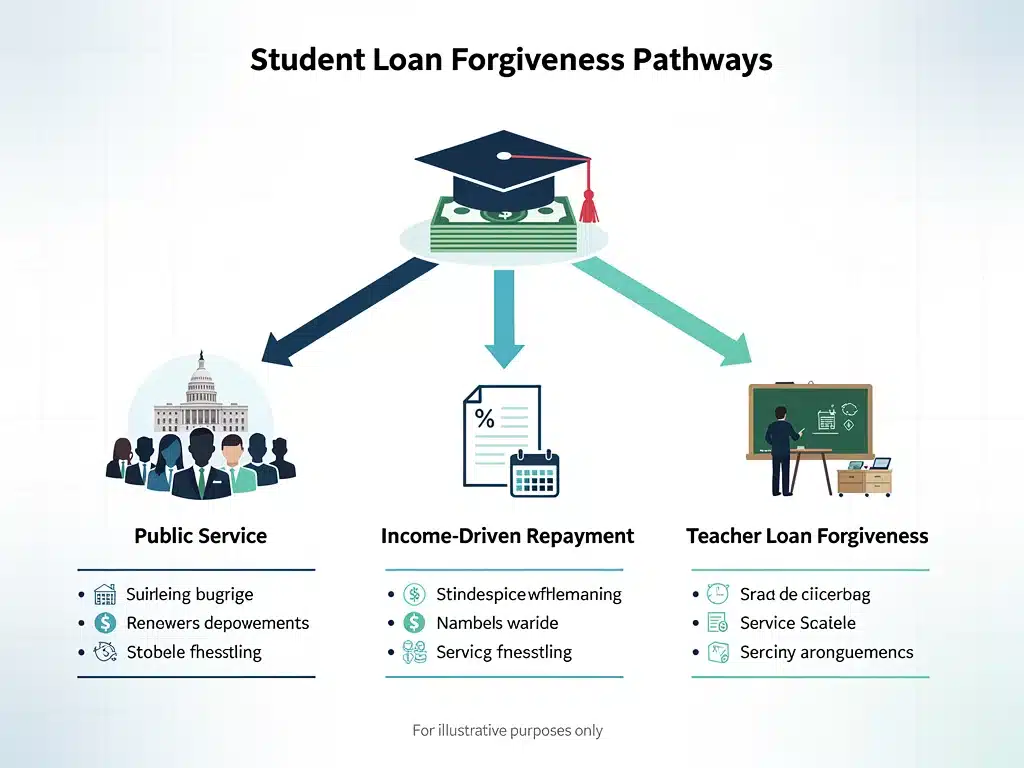
- Public Service Loan Forgiveness (PSLF): Designed for borrowers working full-time for qualifying non-profit organizations or government agencies after making 120 qualifying monthly payments.
- Teacher Loan Forgiveness (TLF): Offers forgiveness for teachers who work for five complete and consecutive academic years in low-income schools or educational service agencies.
- Income-Driven Repayment (IDR) Plan Forgiveness: After 20 or 25 years of payments under an IDR plan, any remaining balance on federal student loans may be forgiven.
- Total and Permanent Disability (TPD) Discharge: Provides forgiveness for borrowers who are totally and permanently disabled, preventing them from engaging in substantial gainful activity.
Each of these programs addresses a unique demographic or situation, reflecting a multifaceted approach to student debt relief. Understanding which program might align with your circumstances is the first step toward potential forgiveness. The eligibility criteria can be complex, often requiring meticulous record-keeping and a thorough understanding of federal guidelines.
Recent Policy Changes and Their Impact
The student loan environment has been dynamic, with recent policy changes impacting how forgiveness programs operate. These changes, often driven by economic conditions or shifts in political priorities, can significantly alter a borrower’s path to relief. It’s essential to not only know about existing programs but also to understand how they are being modified.
For instance, the Public Service Loan Forgiveness (PSLF) program has seen temporary waivers and adjustments in recent years, making it easier for some borrowers to qualify. These temporary measures highlight the potential for future reforms that could expand access to forgiveness. Borrowers must remain vigilant and informed about any new announcements from the Department of Education.
The current landscape suggests a continued effort to refine and possibly expand student loan relief options. While broad-based forgiveness remains a topic of debate, targeted programs are likely to continue evolving. Staying informed about these developments will be critical for anyone planning their financial future around student loan debt.
Eligibility Criteria for 2026 Federal Student Loan Forgiveness
Determining eligibility for federal student loan forgiveness programs in 2026 will likely hinge on a combination of factors, including loan type, employment history, income levels, and repayment behavior. These criteria are designed to target relief to specific groups of borrowers and situations. A careful review of your individual circumstances against these requirements is essential.
It’s important to distinguish between different types of federal student loans, as not all loans qualify for all forgiveness programs. For example, older Federal Family Education Loan (FFEL) Program loans or Perkins Loans might require consolidation into a Direct Loan to become eligible for certain programs, such as PSLF or IDR forgiveness. Understanding your loan portfolio is a critical first step.
Qualifying Loan Types and Consolidation
The type of federal loan you hold is a primary determinant of your eligibility for forgiveness programs. Direct Loans are generally the most flexible and widely accepted for various forgiveness initiatives. If you have other types of federal loans, consolidation might be necessary.
- Direct Subsidized Loans: Fully eligible for most federal forgiveness programs.
- Direct Unsubsidized Loans: Also fully eligible for most federal forgiveness programs.
- Direct PLUS Loans: Eligible for PSLF and IDR forgiveness, though specific IDR plans might vary.
- Federal Family Education Loan (FFEL) Program Loans: Often require consolidation into a Direct Loan to become eligible for PSLF or IDR forgiveness.
- Federal Perkins Loans: Similar to FFEL loans, consolidation into a Direct Loan is typically needed for broader forgiveness options.
Loan consolidation involves combining multiple federal student loans into a single new Direct Consolidation Loan. This process can simplify your repayment and make you eligible for programs you previously weren’t. However, it’s crucial to understand that consolidation can also reset your payment count for forgiveness programs, so careful consideration and professional advice are recommended.
Employment and Income Requirements
Many federal student loan forgiveness programs are tied to specific employment sectors or income levels, reflecting a policy aim to support certain professions or assist financially struggling borrowers. These requirements are often quite strict and require consistent adherence over many years.
For instance, PSLF requires full-time employment with a qualifying employer, which includes government organizations at any level (federal, state, local, or tribal) and not-for-profit organizations that are tax-exempt under Section 501(c)(3) of the Internal Revenue Code. The definition of ‘full-time’ and ‘qualifying employer’ is specific and must be met consistently throughout the required payment period.
Income-driven repayment plans, which can lead to forgiveness, base your monthly payment on your income and family size. This ensures that payments are affordable, but it also means that your income must be low enough relative to your debt to benefit from the forgiveness aspect after 20 or 25 years. These plans are designed to prevent default and provide a safety net for borrowers with lower earning potential.
In conclusion, eligibility for 2026 federal student loan forgiveness is a multi-faceted issue, requiring borrowers to assess their loan types, employment, and income. Proactive research and understanding of these criteria are vital to successfully navigating the path to loan relief.
Application Process and Required Documentation
The application process for federal student loan forgiveness programs can be complex, often requiring meticulous documentation and adherence to specific deadlines. Preparing in advance and understanding what documents you’ll need can significantly streamline the process and prevent delays or rejections. The Department of Education provides various forms and guidelines, but navigating them requires careful attention to detail.
Each forgiveness program has its own unique application steps, though there are common threads across many of them. Generally, you’ll need to demonstrate your eligibility, provide proof of employment or disability, and track your payment history. Staying organized throughout this journey is paramount.

Key Documents for Application
Gathering the correct documentation is often the most time-consuming part of the application process. Missing or incorrect documents can lead to significant delays or even denial of your forgiveness request. It’s advisable to start collecting these well in advance of any application deadlines.
- Loan Statements and History: Proof of your federal student loan balances and repayment history, often available through your loan servicer’s portal.
- Employment Certification Forms: For PSLF, these forms must be completed by your employer to verify qualifying employment.
- Income Documentation: Tax returns, pay stubs, or other proof of income for income-driven repayment plans.
- Disability Documentation: Medical records or Veterans Affairs (VA) disability determinations for Total and Permanent Disability (TPD) discharge.
For programs like PSLF, submitting an Employment Certification Form (ECF) annually, or whenever you change employers, is highly recommended. This helps track your progress toward the required 120 qualifying payments and can catch any issues early on, preventing surprises when you apply for forgiveness.
Navigating Online Portals and Forms
Most federal student loan forgiveness applications and related forms are managed through online portals provided by the Department of Education or your loan servicer. Familiarizing yourself with these platforms is crucial for a smooth application experience. These portals often provide tools for tracking your progress and submitting documents electronically.
The Federal Student Aid (FSA) website is a central hub for information and resources, including links to application forms and detailed guides. It’s important to create an FSA ID if you don’t already have one, as this will be your primary credential for accessing federal student aid information and services.
When filling out forms, always double-check for accuracy and completeness. Even small errors can lead to processing delays. If you have any doubts, consider contacting your loan servicer or a reputable student loan counselor for assistance. They can often provide guidance specific to your situation and help ensure your application is submitted correctly.
In summary, a successful application for federal student loan forgiveness in 2026 requires thorough preparation, accurate documentation, and effective navigation of online resources. Proactivity in this stage can save significant time and stress.
Strategic Planning for Maximizing Forgiveness Opportunities
Beyond simply understanding eligibility and application procedures, strategic planning is essential to maximize your chances of receiving federal student loan forgiveness in 2026. This involves making informed decisions about your repayment plan, managing your employment, and staying vigilant about policy changes. A proactive approach can significantly impact the amount of debt relief you ultimately receive.
Many borrowers find themselves in situations where a slight adjustment to their repayment strategy or career path could unlock substantial forgiveness benefits. It’s not just about waiting for forgiveness; it’s about actively positioning yourself to qualify for it.
Choosing the Right Repayment Plan
Your choice of repayment plan can be a critical factor in qualifying for certain forgiveness programs, particularly those tied to income-driven repayment (IDR). There are several IDR plans, and selecting the one that best fits your financial situation and forgiveness goals is crucial.
- SAVE Plan (formerly REPAYE): Often offers the lowest monthly payments for many borrowers and can lead to forgiveness after 20 or 25 years, depending on loan type.
- PAYE Plan (Pay As You Earn): Caps payments at 10% of discretionary income and offers forgiveness after 20 years.
- IBR Plan (Income-Based Repayment): Caps payments at 10% or 15% of discretionary income, with forgiveness after 20 or 25 years.
- ICR Plan (Income-Contingent Repayment): An older IDR plan, payments are capped at 20% of discretionary income or what you’d pay on a fixed 12-year plan, whichever is less.
For borrowers pursuing Public Service Loan Forgiveness (PSLF), making payments under an IDR plan is almost always the most beneficial strategy. This is because IDR plans often result in lower monthly payments, which means more of your loan balance remains to be forgiven after 120 qualifying payments.
Monitoring Employment and Certification
For programs like PSLF and Teacher Loan Forgiveness, consistent qualifying employment is non-negotiable. It’s not enough to simply work in a qualifying role; you must also ensure your employment is properly certified and tracked over time. This ongoing management is key to successful forgiveness.
Regularly submitting the PSLF Employment Certification Form (ECF) is a best practice. This allows the Department of Education to confirm your employer’s eligibility and track your qualifying payments. If you switch jobs, submit a new ECF for your previous employer and then for your new employer as soon as possible. This proactive approach helps to avoid discrepancies and ensures your payment count is accurate.
Furthermore, understanding the specific requirements for full-time employment and what constitutes a qualifying employer is vital. Don’t assume; verify these details with your loan servicer or the Department of Education directly. A misinterpretation could lead to payments not counting towards forgiveness.
Strategic planning in student loan forgiveness involves a careful balance of choosing the right repayment plan and diligently managing employment certification. These steps are crucial for maximizing your potential for debt relief.
Potential Changes and Future Outlook for 2026
The landscape of federal student loan forgiveness is dynamic, influenced by legislative actions, administrative decisions, and economic conditions. As we look towards 2026, it’s prudent to anticipate potential changes that could impact existing programs or introduce new avenues for relief. Staying informed about these developments is crucial for any borrower planning their financial future.
While specific predictions are challenging, historical trends suggest that policymakers will continue to address student loan debt, albeit with varying approaches. The ongoing debate around the affordability of higher education and the burden of student debt keeps these issues at the forefront of policy discussions.
Legislative and Administrative Initiatives
Both Congress and the Executive Branch have the power to enact significant changes to federal student loan programs. Legislative initiatives could introduce new forgiveness programs, modify existing ones, or alter eligibility criteria. Administrative actions, often through the Department of Education, can also refine how programs are implemented and managed.
For example, the Biden administration has already taken steps to expand access to PSLF and address issues with income-driven repayment plans. These administrative fixes demonstrate a willingness to use existing authority to provide relief. Looking forward to 2026, similar actions could be taken to streamline processes or broaden eligibility for certain groups.
Borrowers should pay close attention to official announcements from the Department of Education and legislative bodies. Subscribing to newsletters or alerts from reliable sources can help ensure you don’t miss critical updates that could affect your eligibility or application process.
Economic Factors and Their Influence
Economic conditions often play a significant role in shaping student loan policy. Periods of economic downturn or high unemployment can spur calls for greater debt relief, while periods of stability might lead to less aggressive policy changes. The economic outlook leading up to 2026 could therefore influence the direction of federal student loan forgiveness programs.
Inflation, interest rates, and the overall job market can all contribute to the pressure on borrowers and, consequently, on policymakers to act. If the cost of living continues to rise, or if the job market faces challenges, there might be increased momentum for expanded forgiveness options.
Conversely, a strong economy might lead to a focus on other aspects of higher education finance, such as preventing future debt accumulation. Understanding these broader economic contexts can help borrowers anticipate potential shifts in policy and plan accordingly.
In conclusion, the future of federal student loan forgiveness in 2026 is likely to be shaped by a combination of legislative, administrative, and economic factors. Proactive monitoring of these influences is vital for borrowers seeking to maximize their debt relief opportunities.
Common Pitfalls and How to Avoid Them
Navigating federal student loan forgiveness programs can be fraught with potential pitfalls that can delay or even derail your path to debt relief. Many borrowers encounter issues related to incorrect information, missed deadlines, or a lack of understanding of program specifics. Awareness of these common mistakes is the first step toward avoiding them.
The complexity of these programs means that even minor errors can have significant consequences. Taking the time to understand the nuances and being diligent in your application and record-keeping can save you considerable frustration and ensure a smoother process.
Misunderstanding Loan Types and Eligibility
One of the most frequent mistakes borrowers make is not fully understanding which of their loans qualify for which programs. As discussed earlier, not all federal loans are treated equally, and private loans are generally not eligible for federal forgiveness programs at all.
Before embarking on any forgiveness application, verify the type of each of your loans. If you have FFEL or Perkins Loans, explore consolidation options if you intend to pursue PSLF or IDR forgiveness. Do not assume your loans qualify without explicit confirmation from your loan servicer or the Department of Education.
Furthermore, pay close attention to the specific eligibility criteria for each program. For instance, PSLF requires full-time employment with a qualifying employer. Working for a contractor that serves a non-profit, but isn’t a non-profit itself, often does not qualify. Always verify your employer’s eligibility.
Incomplete Documentation and Missed Deadlines
The adage “the devil is in the details” certainly applies to student loan forgiveness applications. Incomplete documentation is a leading cause of application delays and rejections. Every form, every signature, and every piece of supporting evidence must be accurate and submitted on time.
For PSLF, failing to submit the Employment Certification Form (ECF) regularly can lead to significant issues down the line, as your payment count might not be accurate. Similarly, for IDR plans, failing to recertify your income and family size annually can cause your monthly payments to increase significantly, potentially impacting your ability to make qualifying payments.
Set reminders for annual recertifications and for submitting any required forms. Keep copies of all submitted documents and correspondence with your loan servicer and the Department of Education. This meticulous record-keeping can be invaluable if disputes arise.
Ignoring Communication from Loan Servicers
Loan servicers are your primary point of contact for managing your student loans. Ignoring their communications, whether by mail or email, is a common mistake that can lead to missed opportunities or critical information going unaddressed. These communications often contain important updates about your loan status, repayment plan, or program eligibility.
Make sure your contact information with your loan servicer is always up-to-date. Open and read all correspondence promptly. If you receive a notice about an upcoming deadline, a change in your repayment plan, or a request for additional information, act on it immediately.
By understanding and actively avoiding these common pitfalls, borrowers can significantly improve their chances of successfully navigating federal student loan forgiveness programs in 2026 and beyond. Diligence and attention to detail are your best allies.
Resources and Support for Borrowers
Navigating the complex world of federal student loan forgiveness can be daunting, but borrowers are not alone. A wealth of resources and support channels are available to help understand eligibility, manage applications, and address specific challenges. Knowing where to turn for reliable information and assistance is a crucial part of the journey toward debt relief.
From official government websites to non-profit counseling services, various entities are dedicated to helping borrowers make informed decisions and successfully pursue forgiveness opportunities. Leveraging these resources can provide clarity and confidence throughout the process.
Official Government Resources
The most authoritative and up-to-date information on federal student loan forgiveness programs comes directly from the U.S. Department of Education and its associated agencies. These resources should always be your first stop for accurate guidance.
- Federal Student Aid (FSA) Website: StudentAid.gov is the official website for federal student aid. It provides comprehensive information on all federal loan programs, including detailed explanations of forgiveness options, eligibility requirements, and application forms.
- Your Loan Servicer: Your loan servicer is responsible for managing your federal student loans. They can provide specific information about your loan balances, payment history, and how to apply for various programs. You can find your servicer’s contact information on StudentAid.gov.
- Department of Education Call Center: For general inquiries or assistance with federal student aid, the Department of Education operates a call center that can provide guidance.
It is critical to rely on official sources to avoid misinformation, which can be prevalent in online forums or from unofficial advisors. Always cross-reference information with StudentAid.gov.
Non-Profit Counseling and Financial Advisors
Beyond government resources, many non-profit organizations offer free or low-cost counseling services to help borrowers understand their student loan options. These counselors can provide personalized advice, help you navigate complex forms, and develop a strategic repayment plan.
Look for organizations accredited by the National Foundation for Credit Counseling (NFCC) or the Financial Counseling Association of America (FCAA). These organizations adhere to high standards of ethics and professionalism, ensuring you receive reliable and unbiased advice. A good financial advisor specializing in student loans can help you assess your unique situation and identify the best path forward.
While some private companies offer student loan assistance services, exercise caution. Always research their reputation, fees, and services thoroughly. Be wary of any company that charges upfront fees for services you can get for free from the Department of Education or promises guaranteed forgiveness.
Accessing the right resources and support can significantly ease the burden of navigating federal student loan forgiveness programs. By utilizing official government channels and reputable counseling services, borrowers can make informed decisions and increase their chances of successful debt relief.
The Importance of Staying Informed and Proactive
In the evolving landscape of federal student loan forgiveness, the ability to stay informed and proactive is perhaps the most critical skill a borrower can possess. Policies can change, new programs may emerge, and existing requirements might be modified. A passive approach could lead to missed opportunities or unintended complications, whereas an engaged borrower is better positioned to leverage every available avenue for relief.
This commitment to continuous learning and active management of your student loans extends beyond just the application phase; it’s a long-term strategy. The financial well-being of millions of Americans hinges on their ability to adapt to these changes and make timely, informed decisions.
Continuous Monitoring of Policy Updates
Federal student loan policies are not static. They are subject to legislative debate, administrative review, and often public pressure. What is true today regarding eligibility or program specifics might evolve by 2026 or even sooner. Therefore, continuous monitoring of official announcements and reputable news sources is indispensable.
Subscribe to email updates from the Department of Education, follow relevant government agencies on social media, and regularly check established financial news outlets that cover student loan policy. Being among the first to know about a new waiver, an extended deadline, or a program modification can be the difference between qualifying for thousands in forgiveness and missing out.
Furthermore, understand that temporary measures, while beneficial, are often time-sensitive. Acting quickly once such opportunities are announced is crucial. Procrastination in this area can be costly, as deadlines for these temporary programs are rarely extended indefinitely.
Maintaining Accurate Records and Communication
A proactive approach also involves meticulous record-keeping and consistent communication with your loan servicer. As discussed, documentation is key to proving eligibility and tracking progress towards forgiveness. This isn’t a one-time task but an ongoing responsibility.
- Keep copies of all loan documents: This includes promissory notes, repayment agreements, and any correspondence from your servicer.
- Document all payments: Maintain records of every payment made, including dates and amounts. While your servicer tracks this, having your own records provides a crucial backup.
- Retain employment certification forms: For PSLF, keep copies of all submitted ECFs and confirmation that they were processed.
- Update contact information: Ensure your loan servicer always has your current mailing address, email, and phone number.
Regularly check your loan servicer’s online portal for updates and to review your payment history. If you notice any discrepancies, contact your servicer immediately to rectify them. Proactive communication can resolve issues before they escalate and potentially impact your forgiveness eligibility.
In conclusion, staying informed and proactive is not merely a recommendation but a necessity for anyone seeking federal student loan forgiveness in 2026. By committing to continuous learning, meticulous record-keeping, and open communication, borrowers can significantly enhance their prospects for successful debt relief.
| Key Aspect | Brief Description |
|---|---|
| Eligibility Check | Verify loan types, employment status, and income against specific program requirements (e.g., PSLF, IDR). |
| Documentation | Gather all necessary records: loan statements, employment certification forms, and income proof. |
| Strategic Planning | Select the optimal repayment plan, proactively monitor policy changes, and maintain communication with servicers. |
| Resources & Support | Utilize official government websites (StudentAid.gov) and reputable non-profit counseling services for guidance. |
Frequently Asked Questions About 2026 Federal Student Loan Forgiveness
While targeted federal student loan forgiveness programs are expected to continue, broad-based forgiveness for all borrowers remains subject to ongoing legislative and administrative decisions. Borrowers should focus on existing programs like PSLF or IDR forgiveness, which have clear pathways to relief, and stay informed on any new policy developments.
To determine if your employer qualifies for PSLF, they must be a government organization (federal, state, local, or tribal) or a not-for-profit organization that is tax-exempt under Section 501(c)(3) of the Internal Revenue Code. You can verify this by submitting an Employment Certification Form (ECF) to the Department of Education.
The SAVE Plan (Saving on a Valuable Education) is a new income-driven repayment (IDR) plan designed to lower monthly payments for many borrowers. It often results in the lowest payments and can lead to forgiveness of remaining balances after 20 or 25 years of qualifying payments, depending on the loan type.
Yes, consolidating certain federal loans (like FFEL or Perkins Loans) into a Direct Consolidation Loan can make them eligible for programs like PSLF and some income-driven repayment plans. However, consolidation resets your payment count for forgiveness, so it’s crucial to understand the implications before proceeding.
If your application for federal student loan forgiveness is denied, carefully review the denial letter to understand the reason. You typically have the right to appeal the decision. Gather additional supporting documentation, seek advice from your loan servicer or a non-profit counselor, and resubmit your application with the corrected information.
Conclusion
Navigating the 2026 Federal Student Loan Forgiveness Programs: Eligibility and Application Tips requires a proactive, informed approach from borrowers. While the landscape of student loan relief can seem complex and subject to change, understanding the established pathways such as PSLF, IDR plans, and specialized discharges remains paramount. By diligently verifying loan types, meticulously preparing documentation, strategically choosing repayment plans, and staying continuously informed about policy updates, borrowers can significantly enhance their prospects for achieving debt relief. Leveraging official government resources and reputable counseling services will further empower individuals to successfully manage their student loan journey, moving closer to financial freedom.