Quantum Computing Platforms 2026: A Data-Driven Comparison

This article provides a data-driven comparison of the three leading quantum computing platforms expected to dominate the landscape in 2026, offering insights into their architectural approaches, performance metrics, and potential applications.
In the rapidly evolving world of advanced technology, understanding the true capabilities and future trajectories of emerging fields is crucial. This article delves into a data-driven comparison of 3 leading quantum computing platforms for 2026, moving past speculative claims to examine tangible progress and projected impact.
The Dawn of Practical Quantum Computing
Quantum computing, once a theoretical marvel, is rapidly transitioning into a tangible technology with the potential to revolutionize industries from pharmaceuticals to finance. The year 2026 is anticipated to be a pivotal moment, with significant advancements in qubit stability, error correction, and algorithmic development making these platforms more accessible and powerful than ever before. This section explores the foundational principles driving this progress and sets the stage for our detailed comparison.
The journey from concept to practical application involves overcoming immense engineering and scientific challenges. Researchers are constantly pushing the boundaries of what’s possible, leading to diverse architectural approaches that each offer unique advantages and disadvantages. Understanding these underlying technologies is key to appreciating the comparative strengths of leading platforms.
Understanding Qubit Modalities
Different quantum computing platforms utilize various types of qubits, each with distinct characteristics that influence performance, scalability, and error rates. The choice of qubit modality is a fundamental differentiator among the leading contenders.
- Superconducting Qubits: These rely on Josephson junctions and operate at extremely low temperatures, offering fast gate operations but requiring complex cryogenic infrastructure.
- Trapped Ions: Individual atomic ions are suspended in electromagnetic fields and manipulated with lasers, known for high coherence and connectivity.
- Photonic Qubits: Using photons as qubits, these systems leverage existing optical technologies and can operate at room temperature, but face challenges in scalability and interaction.
- Topological Qubits: A theoretical approach aiming for inherent error correction, promising highly stable qubits but still largely in the research phase.
The selection of a qubit modality significantly impacts a platform’s development roadmap and its suitability for specific quantum algorithms. Each modality presents a unique set of engineering hurdles and opportunities for innovation, shaping the competitive landscape of quantum computing.
As we move towards 2026, the focus is shifting from simply demonstrating quantum supremacy to building fault-tolerant quantum computers capable of solving real-world problems. This requires not only more qubits but also higher-quality qubits with longer coherence times and lower error rates. The platforms discussed in this comparison are at the forefront of addressing these critical challenges.
IBM Quantum: Scaling Superconducting Architectures
IBM has consistently been a frontrunner in quantum computing, primarily leveraging superconducting qubits. Their roadmap for 2026 focuses on increasing qubit count, improving coherence, and advancing error mitigation techniques. IBM’s strategy emphasizes a modular approach, aiming to link multiple quantum processors to create larger, more powerful systems. This section details their current progress and future ambitions.
The IBM Quantum Experience has made quantum computing accessible to a global community of researchers and developers, fostering innovation and accelerating the development of quantum algorithms. Their continuous release of increasingly powerful processors, such as the ‘Eagle’ and ‘Osprey’ processors, showcases their commitment to rapid iteration and scaling.
Key Strengths and Innovations
IBM’s platform stands out due to its robust ecosystem and a clear, ambitious scaling strategy. Their focus on superconducting qubits has allowed for significant progress in gate speeds and connectivity.
- High Qubit Counts: IBM has consistently delivered processors with increasing numbers of qubits, pushing the boundaries of what’s physically possible with superconducting technology.
- Qiskit Ecosystem: A comprehensive open-source SDK that provides tools for building and running quantum programs, fostering a large and active developer community.
- Modular Architecture: Their plan to interconnect multiple quantum processors via quantum communication links promises unprecedented scalability for future systems.
- Error Mitigation Techniques: Active research and implementation of advanced error mitigation strategies to extract more accurate results from noisy intermediate-scale quantum (NISQ) devices.
The challenge for IBM lies in maintaining qubit coherence at scale and effectively managing the complexity of larger, interconnected systems. However, their established infrastructure and extensive research capabilities position them well to address these hurdles. By 2026, IBM aims to showcase fault-tolerant quantum computation capabilities, moving beyond the NISQ era.
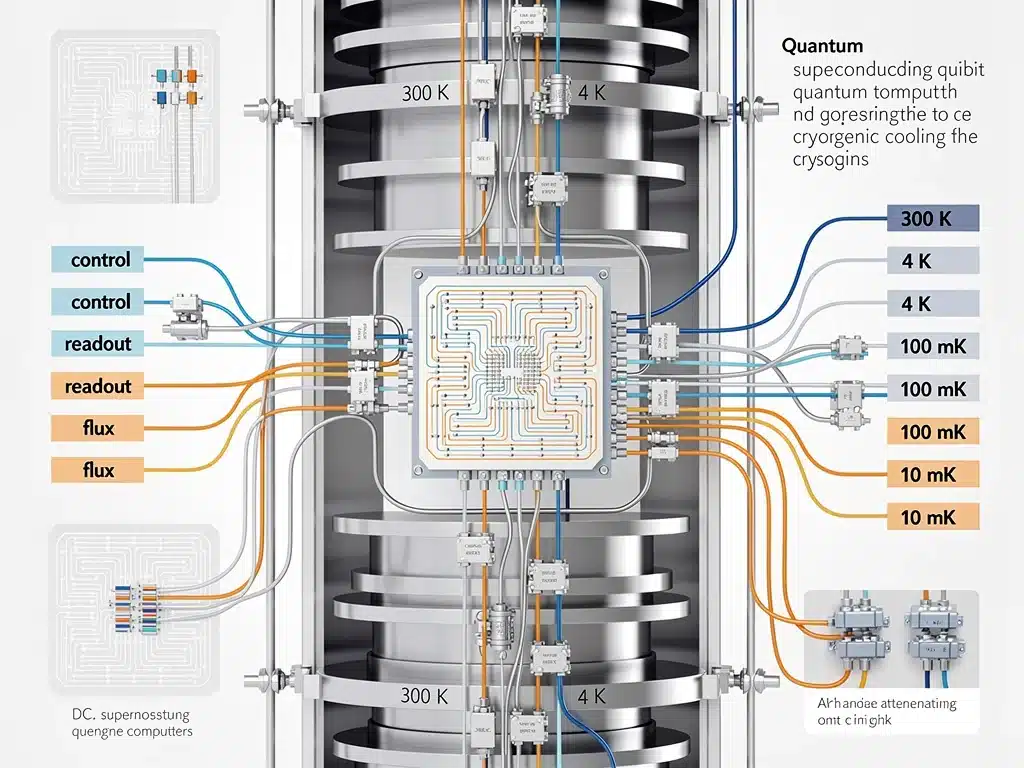
IBM’s commitment to open science and collaboration through its quantum network has also been a significant factor in its leadership position. This collaborative approach not only accelerates research but also helps in identifying real-world applications that can benefit from quantum advantage, further solidifying their market position.
Google Quantum AI: Pushing the Boundaries of Quantum Supremacy
Google Quantum AI, renowned for achieving quantum supremacy with their ‘Sycamore’ processor, continues to innovate with superconducting qubits. Their primary focus remains on developing increasingly powerful quantum processors and exploring applications in areas like quantum chemistry and materials science. This section examines Google’s advancements and strategic direction for 2026.
Google’s approach emphasizes demonstrating practical applications where quantum computers can outperform classical ones, a concept often referred to as ‘quantum advantage.’ Their research often involves highly specialized experiments designed to highlight the unique computational power of their quantum hardware.
Architectural Focus and Performance
Google’s superconducting qubit architecture is designed for high connectivity and low error rates, crucial for complex quantum algorithms. Their advancements often involve bespoke chip designs optimized for specific computational tasks.
- Sycamore Processor Lineage: Continued development from the ‘Sycamore’ processor, focusing on improved qubit quality, connectivity, and gate fidelity.
- Application-Specific Hardware: Google often designs hardware tailored to specific research questions or application domains, pushing the envelope in targeted areas.
- Quantum Algorithms Research: Significant investment in developing novel quantum algorithms, particularly for simulations in chemistry and physics.
- Error Correction Research: Pioneering efforts in quantum error correction, a critical step towards building fault-tolerant quantum computers.
The proprietary nature of some of Google’s advancements means that while their breakthroughs are significant, broader accessibility can sometimes lag behind platforms like IBM. However, their commitment to fundamental research and pushing the limits of quantum hardware makes them a formidable player in the race for practical quantum computing. By 2026, Google aims to showcase more compelling demonstrations of quantum advantage in industrially relevant problems.
Google’s deep expertise in artificial intelligence also positions them uniquely to explore the intersection of AI and quantum computing. This synergy could unlock new paradigms for machine learning and optimization, further distinguishing their platform in the competitive landscape of quantum computing platforms.
IonQ: The Promise of Trapped-Ion Technology
IonQ has emerged as a leading contender by focusing on trapped-ion quantum computing, a modality known for its high qubit coherence and all-to-all connectivity. Their platform offers a different set of advantages compared to superconducting systems, making it particularly suitable for certain types of quantum algorithms. This section explores IonQ’s unique strengths and their vision for 2026.
Trapped-ion systems operate by suspending individual atoms in a vacuum and manipulating them with lasers. This approach allows for very high fidelity operations and the ability to move qubits around, enabling complex interactions without physical connections, which is a significant advantage for certain algorithms.
Distinct Advantages and Future Outlook
IonQ’s trapped-ion technology offers distinct benefits, particularly in terms of qubit quality and programmability. Their systems tend to have longer coherence times and lower error rates per gate operation.
- High Qubit Coherence: Trapped ions maintain their quantum state for longer periods, reducing errors and allowing for more complex computations.
- All-to-All Connectivity: Any qubit can interact with any other qubit, simplifying algorithm design and improving efficiency for many quantum circuits.
- Room Temperature Operation (for control electronics): While the ions themselves are cooled, the overall system can be less demanding than superconducting systems in terms of cryogenic infrastructure.
- Modular and Scalable Design: IonQ’s architecture is inherently modular, allowing for the potential to link multiple ion traps to scale up the number of qubits.
While trapped-ion systems offer superior qubit quality, the speed of gate operations can sometimes be slower than superconducting qubits. However, ongoing research is addressing these speed limitations, and the inherent stability of trapped ions makes them an attractive option for future fault-tolerant quantum computers. IonQ’s roadmap for 2026 includes further increasing qubit count while maintaining their high fidelity, making their platform increasingly competitive among leading quantum computing platforms.

IonQ’s commercial strategy, which includes offering quantum computing as a service through major cloud providers, has also expanded its reach and made its unique technology accessible to a broader user base. This strategic positioning is critical for gathering user feedback and accelerating practical applications.
Performance Metrics and Benchmarking for 2026
Comparing quantum computing platforms is not simply about qubit count; it involves a complex interplay of various performance metrics. For 2026, key benchmarks will include quantum volume, gate fidelity, coherence times, and the ability to run increasingly complex algorithms. This section provides a data-driven perspective on how these platforms are expected to stack up.
Quantum volume, introduced by IBM, is a holistic metric that attempts to quantify the effective computational power of a quantum computer by considering both qubit count and error rates. While not perfect, it provides a useful snapshot of overall performance. Other metrics, such as average gate fidelity and qubit connectivity, offer more granular insights into hardware quality.
Key Comparative Metrics
Evaluating the leading platforms requires looking beyond raw numbers to understand the quality and utility of their quantum resources. The following metrics will be crucial in 2026:
- Quantum Volume: Expected to significantly increase across all platforms, indicating greater effective computational power.
- Average Gate Fidelity: The accuracy of quantum operations, with higher fidelity leading to more reliable results. Trapped-ion systems often excel here.
- Coherence Time: How long qubits can maintain their quantum state, directly impacting the complexity of runnable algorithms.
- Qubit Connectivity: The ability for any qubit to interact with others, influencing algorithm efficiency and hardware design.
- Error Correction Progress: The advancement towards fault-tolerant quantum computing, including the implementation of logical qubits.
By 2026, we anticipate that while superconducting platforms like IBM and Google will lead in raw qubit counts, trapped-ion systems from IonQ will offer superior coherence and connectivity, making them strong contenders for specific types of quantum algorithms that benefit from high-fidelity, all-to-all interactions. The race will not be about a single winner, but rather about which platform proves most effective for different classes of problems.
The development of standardized benchmarks will also play a critical role in objectively comparing these diverse platforms. As the field matures, the community will increasingly rely on these metrics to assess progress and identify the most promising avenues for further research and development in quantum computing platforms.
Emerging Applications and Industry Impact by 2026
The advancements in quantum computing platforms by 2026 are expected to unlock a new era of applications across various industries. From drug discovery to financial modeling, quantum computers promise to solve problems currently intractable for even the most powerful classical supercomputers. This section explores the most promising application areas and their anticipated impact.
The ability of quantum computers to process information in fundamentally different ways opens doors to solutions for complex optimization problems, simulations of molecular structures, and enhanced machine learning algorithms. Early adopters are already exploring how these capabilities can provide a competitive edge in their respective fields.
Transformative Application Areas
The potential impact of quantum computing is vast, touching nearly every sector. By 2026, we expect to see more concrete demonstrations and early-stage commercial applications in these key areas:
- Drug Discovery and Materials Science: Simulating molecular interactions with unprecedented accuracy, accelerating the development of new drugs and advanced materials.
- Financial Modeling: Optimizing portfolios, risk assessment, and fraud detection with complex quantum algorithms.
- Logistics and Optimization: Solving highly complex combinatorial optimization problems, such as supply chain management and traffic flow optimization.
- Artificial Intelligence and Machine Learning: Enhancing AI capabilities with quantum machine learning algorithms, potentially leading to more powerful and efficient models.
- Cryptography: Developing new quantum-safe cryptographic methods and potentially breaking existing encryption standards.
While full-scale commercial deployment of fault-tolerant quantum computers might still be some years away, the progress by 2026 will enable proof-of-concept solutions and early quantum advantage in specific, well-defined problems. Companies that invest early in understanding and integrating quantum capabilities will likely gain a significant competitive advantage. The impact will extend beyond individual companies, potentially reshaping entire industries and creating new economic opportunities.
The collaborative efforts between quantum hardware developers, software engineers, and industry experts are crucial for translating theoretical quantum advantages into practical, impactful solutions. This ecosystem development is as important as hardware advancements in realizing the full potential of quantum computing platforms.
Challenges and the Road Ahead for Quantum Computing
Despite rapid progress, the path to widespread quantum computing adoption is fraught with significant challenges. These include maintaining qubit stability, achieving robust error correction, developing accessible programming tools, and educating a new generation of quantum engineers and scientists. This section addresses the hurdles that all leading platforms must overcome to realize their full potential by 2026 and beyond.
The delicate nature of quantum states, known as coherence, is a primary challenge. Qubits are highly susceptible to environmental noise, which can cause errors and limit the duration of quantum computations. Overcoming this requires sophisticated engineering and innovative error correction techniques.
Key Obstacles to Overcome
The journey towards fault-tolerant quantum computing involves tackling several complex scientific and engineering problems. The following represent the most significant challenges:
- Qubit Coherence and Stability: Protecting qubits from decoherence and environmental noise is paramount for reliable computations.
- Error Correction: Developing and implementing effective quantum error correction codes to manage and correct errors, a prerequisite for fault tolerance.
- Scalability: Increasing the number of high-quality qubits while maintaining their performance and inter-connectivity.
- Software and Algorithm Development: Creating efficient quantum algorithms and user-friendly software tools that can leverage the unique capabilities of quantum hardware.
- Talent Gap: A shortage of skilled quantum engineers, physicists, and programmers to drive research, development, and application.
Each of the leading platforms is actively investing in solutions to these challenges. IBM and Google are pushing the limits of superconducting qubit integration and error mitigation, while IonQ is leveraging the inherent stability of trapped ions. The competitive landscape by 2026 will be defined not just by raw performance, but by how effectively each platform addresses these fundamental limitations. Collaboration across academia, industry, and government will be essential to accelerate progress and overcome these formidable hurdles.
The investment required to develop and maintain these cutting-edge quantum systems is also substantial. Sustained funding, both public and private, will be critical to ensure that research and development continue at the necessary pace to bring quantum computing to its full potential.
| Key Platform | Primary Advantage for 2026 |
|---|---|
| IBM Quantum | Leading in superconducting qubit count and comprehensive ecosystem (Qiskit). |
| Google Quantum AI | Pioneering quantum supremacy demonstrations and targeted algorithm development. |
| IonQ | High qubit coherence and all-to-all connectivity with trapped-ion technology. |
| Overall Trend | Focus on error mitigation, scalability, and application-specific quantum advantage. |
Frequently asked questions about quantum computing platforms
Superconducting qubits operate at extremely low temperatures, offering very fast gate operations. Trapped ions, however, are individual atoms suspended and manipulated by lasers, known for their superior coherence times and all-to-all connectivity, simplifying complex algorithm implementation.
Quantum volume is a performance metric that measures the effective computational power of a quantum computer, considering both the number of qubits and their error rates. It’s crucial because it provides a holistic measure of a quantum system’s capability to run complex algorithms.
No, quantum computers are not expected to replace classical computers by 2026. Instead, they will serve as powerful accelerators for specific, highly complex computational tasks that classical computers struggle with, working in conjunction with traditional systems.
Major challenges include maintaining qubit coherence for longer periods, developing effective quantum error correction, scaling up the number of high-quality qubits, and creating accessible software and algorithms. These are critical for achieving fault-tolerant quantum computing.
Industries can prepare by investing in quantum literacy, exploring potential applications relevant to their domain, collaborating with quantum research institutions, and experimenting with current quantum computing platforms to understand their capabilities and limitations.
Conclusion
The landscape of quantum computing is dynamic and rapidly advancing, with IBM Quantum, Google Quantum AI, and IonQ leading the charge with distinct yet powerful approaches. By 2026, we anticipate significant strides in qubit quality, scalability, and error mitigation across these platforms, moving closer to practical quantum advantage in various sectors. While challenges remain, the data-driven comparison reveals a clear trajectory towards more robust and accessible quantum computing capabilities, promising a transformative impact on technology and innovation.